GABY GRANT

Gaby Grant
Welcome to another Other Ways of Seeing Conversation. This one's with Gaby Grant. She's a creative for Adam and Eve TBWA, which is a classic ad agency name, and it is a classic ad agency. It's very famous and does amazing work. She's also a conceptual artist. Currently, her art practice is also a business, and it's called These Tits Are Mine. This is in her words…
“Gaby is the founder of These Tits Are Mine, an activist clothing brand that creates custom garments printed with people's own tits and chests to help them reclaim and celebrate their bodies.
She started the brand after having her own topless photo leaked on the Internet without her consent as a teenager. Since then she has been on a quest to take ownership back of her body and help others do the exact same, no matter what their story.”
What happened to her was pretty brutal, and here's a trigger warning for anyone who was unfortunate enough to have a similar experience.. which is have someone take a photo that you've sent personally, of your body, and then they put it on the internet. What a bunch of bastards. So, yeah, if this has happened to you, here's a warning that this is what we'll be talking about. We'll also be talking about the Other Ways of Seeing roots, where it all came from, talking about the story behind an artist's work and how important that is. Gaby's influences, including Lily Allen and the Young British Artists, the YBAs and the Sensation exhibition. We also talk about the similarities of conceptual art and advertising. We then delve into the story behind These Tits Are Mine, and I think it's quite a long journey to get there, and maybe the realisation of why she's doing what she's doing, but it's a very interesting one and it's very moving. We also talk about how the business and her art practice fits in with her day job. We discuss if art in advertising can actually exist. And lots of other things in between. It was an amazing conversation. Thank you so much to Gaby. She is such an amazing orator, much better than I am. And I barely had to edit this conversation at all. It was just pure joy.
A little word about our sponsor, hungryman. hungryman is a global commercial production company with offices in London, New York, Los Angeles and Sao Paulo. Hungryman's work spans blockbuster spectacle, sharp comedy, and emotionally driven storytelling. Do check out their website, hungryman.com. You can find all their amazing work on there. They don't just make commercials, they also make art. They make dance activist pieces, films, musicals, and some of those films are Oscar nominated. I mean, it's just amazing. Their scope is huge. Anyway, check them out. I'm very, very pleased to have their support and that they believe in this project. Thanks, hungryman!
And now back to my conversation with Gaby…
Mel: If you want to hear the history of it, it started in 2010, like a really long time ago. And originally it was called Higher Pitch, and it was a project for women in advertising to show that they could do more than write shampoo ads. Because at the time it was.. like it was really bad, it is still quite bad, but you know, I think it's recognised now that you can kind of write anything and and it was a conversation I had with a creative team in Saatchis. And it was exactly that.. It was like, I write books and no one knows.
And I was like, okay, let's do something about it. So I set up these exhibitions.. with someone else called Susie Quill, who I fell out with eventually. Anyway, yeah, so we set up these exhibitions. It was so popular, the first one, and then loads of men were like, ‘we want to do it too!’ so it became Art Sells. So for the next three years we did them. We did one in Cannes after the one in Shoreditch and then the one in Cannes came back to Regent's Park. Actually at Chris's company, Chris Baker.. at Park Village. We did it there as like a sort of refresher reminder thing. And then I moved to Cornwall after a few years of consulting and doing other stuff. And then I came back in the industry and loads of people were like, Why don't you do that again? Because it was a really big thing at the time. It wasn't us just doing it. There were exhibitions around showing work of people in the industry, but it tended to be more of ..like a bit of a marketing gimmick and I was really keen for that not to be then and and so now I live in Cornwall doing this is a way of me being able to kind of do it again, but remotely basically.
Gaby: And taking back sort of the reins of it and shaping it into…
Mel: Yeah, and I think that was the thing before, the exhibitions were great but we didn't really hear the stories behind the art as much.
Gaby: That’s really interesting because often sometimes, like, that gives you a whole different perspective, right? The artists' background and the art. And I mean, especially if you go to like abstract art and abstract expressionist, like, if even as an educated art person, that can be quite like, ‘I have no idea what to do with this’, unless you've kind of got a bit of an explanation as to the movement and the people behind it and where they were in their lives.
Mel: Yeah, read the thing, read the blurb on the wall. Like reading the blurb on the wall makes a really massive difference.
Gaby: Yeah, 100%.
Mel: Yeah. There's so many people I've met though, who have said, ‘oh, I like to go to an art gallery and just and take it all in and I like it or I don't like it’, and that's great, but you get so much more out of it when you when you know the reasons for why it is the way it is.
Gaby: Oh, a hundred percent. I remember the reason I mentioned abstract expressionists because, like, when I was at art school, we did like a trip to London, even though I'm from London, but I was studying in Edinburgh. and we went to like an abstract expressionist exhibition, and it's not like a type of art that I was particularly excited by. And there was like a room I can't remember who painted it now, but it was like all black square of like huge piece of artwork. And like, to be honest, it was just one of those typical ones that you could almost hear the guys in your head being like ‘well, I could do that’. You know, the typical like, ‘well, I could grab a canvas and slap some black paint on it’. And then I thought, you know what? Maybe they're right with this one. Maybe they are right with this one. And then I read the blurb and it actually had like something like 90 different shades of black painted on it. And I didn't even know that there was like 90 shades of black. I thought black was black, right? And and then there was a bit more of the story of behind it and like the what the artist was going through when they painted it and the turmoil and all this. And then like suddenly, you look at it differently, right? Like, suddenly you look at it as ‘can I see all the different shades of black in this one black painting’?
Mel: I think it's amazing. I think that's brilliant. Yeah, you hear that all the time, don't you? You know, ‘I could have done that’, but you didn't. And what would your reasoning be? Like, why would you do it?
Gaby: And also you don't even realise like sometimes what it takes to make a piece of artwork, like even to get a nice canvas and the right paints and the right paintbrush and then like you know, by the time you've slapped some red on a piece of canvas and copied the artwork that's so easy to make, you realise yours looks like shit.
Mel: Yeah, because there's no depth. Like, why would it draw you in? Well, let's start with the first question then. Is there any art or anything in fact you've seen.. it doesn't have to be specifically fine art, it can be film or whatever, that's kind of blown you away?
Gaby: Yeah, I mean, just to say firstly, I haven't prepared for this interview. I thought it'd be nice to just kind of be like free flowing.
Mel: I love it.
Gaby: Yeah, and so everything I say is kind of going to be just like a little bit off the cuff, but obviously as thought through as it can be in the moment. But I mean, when I saw just when I was reading through the list of questions and I read that question, the first thing that came to mind was Lily Allen's new album.
Mel: Oh, really?
Gaby: Yeah, I've always been like a huge fan of Lily Allen for years and years and years and years, even from her first album. And a lot of the music that I listen to is kind of women sort of men bashing in their lyrics. And someone asked me recently, like, why do you love Lily Allen so much? And I just think that she's so brutally honest in the way that she talks about love, relationships, sex, and the media, the press that there's just no hiding, right? Like everyone sees that everyone's being held up a mirror, and that everyone sort of resonates with something because there's no necessarily a happy ending to the songs. There's no like conclusion of ‘but don't worry, everything's going to be okay’, like, I just think that she sort of tells it how it is, and she's been like super heavily criticised but I think the reason… I mean, the the new album is, if you haven't listened to it already, is like an absolute masterpiece, and bashing her ex-husband well, now ex-husband, who was having an affair. But I think what's so interesting is that.. and I was listening to her podcast as well, she was saying that normally, you know, you look for a single to launch the album, and then you're hoping that the single brings in people to want to listen to the album But she didn't write the album like that at all because she just didn't feel like there was a stand out happy pop track that everyone would gravitate to. It's a story from the start to the end. And she said what was really interesting is that when they got the stats as to how people were listening to the album, unlike most music, people were actually listening from the first song all the way through. And that's how I.. I almost struggled to like just pick a song. I always sort of when I go to listen, I play the album from start to finish. Yeah, I mean, I personally just think that that sort of level of honesty and sort of gut punch into saying something about a particular subject that kind of mic drops and makes people just go ‘[gasps]’ like, it's something that I've always tried to do in my own artwork. And it's kind of that shock tactic artwork a little bit that makes you think and wants to dig more into it.
Mel: I’ll definitely have a listen. Yeah, I mean, I remember Lily Allen from years and years and years ago. And she was always contentious and really sort of ‘fuck you’ to the establishment, which was always, you know, very respectful. I never I never had a problem with her. Who are her haters? Men? I'm guessing?
Gaby: Well, I think recently, because her podcast, she I mean, she's left the podcast momentarily because of her album launch, but she does it with her best friend Miquita Oliver, who's a fellow.
Mel: I’ve never watched that.. I've never heard that actually.
Gaby: Yeah, who's like both West London girlies, and obviously Lily Allen's dad's Keith Allen and Mikita Oliver's mum's Andy Oliver. So they've sort of come from artsy, sort of West London-y backgrounds. But what was I going to say? I was going to say, oh, you asked me why she gets so much hate. Well, she just says it as it is. And like, to give an example, she was talking recently about abortion, and she said that she's had five or six abortions, and she laughed when she was talking about it. And if you listen to the whole podcast, you can hear that it's a nervous laugh, that she’s.. you know, there's a slight.. there's mixed feelings of shame, and there's acceptance as well that she wouldn't have wanted to have those children. And there's also like taking away the stigma that people have had probably multiple abortions and maybe don't talk about it. And the Internet just went insane being like, ‘I'm pro abortion, but I still don't believe that you should be laughing about the subject’. But it's so nuanced. And that's the sort of thing that she gets hate from. It's like she talked about getting a dog that she had to return because the dog was just like untrainable. And then it's like ‘Lily Allen, dog abuser’.
Mel: Oh, for fuck sakes.
Gaby: Yeah, that's that's what she gets hate for. And I guess that it's kind of that raw honesty, but she's always super witty, like everything with a pinch of salt. So..
Mel: She’s someone to aspire to, I reckon. I think if you get through.. if you can like hold your head up high through all of that. And as women we all suffer from something like that at some point in our lives or multiple times, and you've just kind of got to power on through and bat it away. Otherwise you let it get to you and it's yeah. It's awful. And do you relate because your work is similarly incredibly honest, this is your artwork… it’s incredibly honest and confrontational.
Gaby: Yeah, I mean, like, I think the stuff that I'm most.. like the artwork I've always been moved by, like the Young British Artists, which obviously, if you look at most of their work in the early nineties, especially with like the Sensation exhibition at the Royal Academy, which I actually went to, but I was a baby, so I feel like somehow it seeped into me, even though I was like a tiny little baby and I wish I would have been older to go to it, but maybe in some weird twist and turn, I was meant to be born in that year in 1997 when they were at the height of them. But I've just always loved artwork that has that shock tactic. Like Marcus Harvey did the Myra Hindley painting with all the children's hands, Jake & Dinos Chapman with, you know, the penises on children's faces and Tracey Emin and Sarah Lucas and Damien Hirst… And I just think that like the artwork I've always gravitated towards is by someone who's got something to say.
So that's like sort of similar to advertising. You're trying to give a message and then you think visually how you're going to bring it to life. So it's almost like message first rather than let's make something look pretty or let's make something that's buyable or sellable. It's like ‘I've got something to say and I have to say it’, even if it's going to annoy people and shock people and anger people. And I think for some reason, ever since I was a teenager, whether it's a collective of experiences or whether I was just born that way, because there's always been sort of something innate in me, like a human, like a curiosity about human sexuality in particular, but that's then, you know, developed because of experiences into different things to have led me to make artwork that is challenging and confrontational and like sometimes just outright offensive.
But I think like if you're not feeling something about art, I don't know if you're doing your job right. And that emotion doesn't always have to be anger and annoyance and confrontation, that’s maybe what I'm trying to do.. but other artists, if even if the emotion is, ‘oh, that's pretty and makes me feel warm inside’, that's still an emotion, right? So I'm not bashing the other side of art. I think it's all valid. But I think for me, the focus, the stronger emotions, the sort of like repulsed or angry or empowered or like, yeah, let's go fucking do something about it is what I've always been drawn to.
Mel: Yeah. I can see that. I mean, I can see from your project These Tits Are Mine, which is awesome and came from an experience that you did have in your early teens. Do you want to elaborate on that? I don't want to tell your story for you.. if you want to share.
Gaby: No, no, I'm super excited to share about it, especially because I've like, I think when I spoke to you, and when we met in, was it, I can't remember what it was now, like June or July.
Mel: Yeah. July, I think it was. Creative circle, yeah.
Gaby: Yeah, I think I was talking about the idea, and I have had the idea for a while, but I actually launched finally in August.
Mel: Congratulations! Yay!
Gaby: Thank you! And yeah, basically when I was thirteen, fourteen, it was like the rise of social media, obviously social media was a thing, and there'd always been, you know, MSN, Skype, BB.. I can't remember what it was called now. I can't think it's called like BB, BBM, and all of those. Like, there was loads of social media and MySpace and all of that. I think like it was sort of starting to get into that element where I was the first generation that went from like, at 13, getting a Nokia, and then at 15 having an iPhone. And I think that.. because before people were using social media, but they were very much doing it on their laptop. So, you had to like go home, connect to the internet, go on your laptop, connect to social media. And it was a very intentional thing. Whereas, suddenly, when everyone got iPhones, you could be on social media all the time at a click a button communicating constantly. And before that I had a Blackberry, and again that had BBM, which was Blackberry Messenger, which also allowed you to send photos and everything. And it was super, super accessible. It was basically like WhatsApp like back then. And I was.. I just remember being so.. when I was given my Blackberry, I was so excited. I think at the time it was like, oh my God, like I was boy obsessed anyway, and I was like, now I can chat to them whenever I want, for however long I want, at whatever time I want. I felt like I was, what my parents gave me, was like connecting me to the world. I was like, oh my god, like the world of boys, basically.
And I was just super excited and I don't think my parents.. like I don't think teachers or parents or anyone really like knew the dangers of what could happen. And so I don't blame anyone for this, but no one just knew what to warn, right? Like at the moment, we kind of know a little bit about what to warn in AI, but then there's things you probably haven't thought of that are happening in schools that you don't know to warn your children against, and you're learning as they do, so it was sort of a bit like that. And I was talking to this boy that I really liked. And he, over a couple of months, was asking me for a photo, a like topless photo. And I sort of like, batted him away, batted him away, batted him away. And then a boyfriend at the time that I was sort of semi-boyfriend, semi-not boyfriend, like broke up with me and I was really sad and it was Christmas and this boy popped up again and was like, ‘oh, go on, send me a picture, send me a picture’. And sort of just for attention, really, and validation, like sent him one and didn't have, like, you know… Maybe I always said if I could go back, maybe I would do it again, but without my face, you know, like there's so many things that would, you know, change the outcome or maybe lessen the consequences. But yeah, I was like fully topless with my face in it and you could see my bedroom, so it was like very, it was like there was no denying that it was me. And a couple of months passed, nothing happened. And then I was on a French exchange and someone messaged me saying, ‘just warning you, like, there's this picture out there’, which is obviously really nice of them…
Mel: When you say it was out there, like, where was it?
Gaby: So, a boy, that boy.. well this is how the story goes… I don't obviously know if like teenage boys obviously have changed the story for their benefit, so I never quite know what's the true story, but he said he didn't delete it, which obviously in the first instance that was the first breach of trust.. And then he didn't delete it, but another boy from school went on his phone, supposedly, saw it and put it in a group chat with twenty boys from five different schools. So most of the time what would happen is it would only circulate round your own school. Teachers would get find out because they'd see people talking or they'd hear about it or the girls' parents would get involved or the girl would go to teacher or whatever, and it'd be stopped and like, you know, it would the spreading would stop. But because mine was to someone outside of my school and it immediately went on a chat with twenty boys from different schools, it was just impossible to contain it. And I always say like, it feels like what happened is it went like viral before like viral was like really a thing because.. maybe other women had the same experience, but it was probably the most viral picture of my generation, across Northwest London and West London.
Mel: Jesus Christ. Like the idea.. because I've got a daughter who's seven, just the idea of that happening is just.. and also not being able to warn her because you wouldn't ever think that something like this that's so I don't know, that's so salacious, that wouldn't come up.
Gaby: I think I was quite unlucky.
Mel: Yeah, clearly, very unlucky.
Gaby: Because there was a lot of girls that did the same, and it just obviously I'm not diminishing their impacts. I think it was like, you know, just as traumatising. But I think some of theirs went away a bit quicker, whereas mine, because it went kind of cross generation, like it went all the way down to my brother's year, who was three years younger than me, and then it went all the way up to like you know, people who were eighteen and then like my dad saw it, my uncle saw it because like there was just, you know, there was just so much, there was just going around everywhere. And at the time people used to have these things called wank banks, like teenage boys used to have wank banks where they'd like collect photos of the girls who'd sent like naked photos. And then, as in the name, they would all..
Mel: Eurgh.. so gross.
Gaby: But, like, you know, like boys would show me their wank banks and be like, Look, you're in my wank bank, and all of this. I'd get added on Facebook and be like, I've seen your tits, or people would be like, you've got big nipples, or people would be like, just say horrible things where you're like, oh, your room's horrible, your face is horrible. Like, just like, oh, the most, the one I'd always get on Facebook is from a random ad. From either a boy in the ear above or a boy in the year below, or a boy in like another school and being like, I've seen your tits. And that's how they'd start the conversation.
Mel: Great start. Like, ‘yeah, I really want to be your friend’.
Gaby: And then some of the more manipulative ones would like be like, I'm so sorry this happened to you. Like, I'm really on your side and like rope you in. And then like sort of flirt with you and then ask you for a picture like three weeks down the line. And obviously, at the time, I didn't have many female friends because I'd like I’d just changed school to a secondary school, and the school I was at before, which is a long story, but I was actually at school for like a year and a half. I was the only girl in my year. And so then I'd gone to this other school and basically I was quite boisterous because I'd I'd been like in my beginning of puberty, like just around boys and I was like very flirty and like just girls just didn't really like me, which was you know, kind of natural, I guess, for like a flirty, tomboyish girl. And so I had no one to like validate me. It was just boys, just like even my.. because I was in a boy group, they would just wind me up about it, even though they weren't my friends. And to me, that was like the best of the situation. So, yeah, I didn't talk to anyone of authority. I didn't talk to anyone at school because girls would get suspended for it, and I didn't want that on my record. I didn't talk to my parents because I felt ashamed and I didn't want to worry them. And I also felt that there was nothing they could do, and it's actually a criminal offence to send a picture, even if it's of yourself and even if it's spread non-consensually, it's seen as spreading underage pornography.
Mel: Even of yourself?
Gaby: Yeah, I mean, it's obviously very rarely prosecuted, but it's still..
Mel: But you're too young, yeah, to be blamed for something like that. Oh man, it's so unfortunate. It's so shit. Because I you know we all know what it's like, and you're sort of in the throes of kind of romance and sexiness and all that, and especially at that age, yeah, you're gonna do really stupid things. But they don't seem stupid and they should be innocent. And it's so unfair..
Gaby: Yeah, I think, like, to be honest, I think there's a lot more awareness now. Like my brother's ten years younger than me, and I have asked him, you know, if it's sort of the same, and he says that it's not really like people are much more aware of what could happen, and yeah, maybe it happens here or there, but in my year, like there were just hundreds of girls that it happened to. And, you know, mine luckily was my boobs, but other girls had like videos of them fingering themselves or like you know, they were like, equally 13, 14, 15 years old. And yeah, I think one girl killed herself at a school near me. It was awful. And also, I think, because.. I don't know if I mentioned this to you, but I've written a book about it.
Mel: No. I don't remember you mentioning that actually. You've actually written a book..
Gaby: Yeah, I'm on the first draft but I've finished the book.
Mel: Right. Oh, amazing. Okay. Wowzers. That's incredible. I feel like and tell me if I'm wrong, but it feels like I mean, it is a truly traumatic event that you've gone through and at such a young age. And clearly, you have something to say. And when you say that your art is confrontational and a bit shouty and all that, it's probably it is because.. you're trying to… you're reacting to it, surely. I mean, here's my pop psychology, but I'd be really fucked off as well. And it would take me a really long time to process, and I wouldn't want to shut up about it. It's just really interesting how you process that into art. And is that perhaps why you went to art college? Was it always there? Was that a way of like being able to express it? And deal with it?
Gaby: It's a really good question because, like, to answer that question, I kind of have to go back in the story and like a little bit, which is that I stayed friends with the guy who sent the photo for like 10 years.
Mel: Wow… who ruined your life, basically.
Gaby: Yeah, I just like I just stayed friends with him for a really long time. I just was like naive, he apologised loads. He like told me he really fancied, really, really liked me. Wants to be my friend, blah blah blah, blah, like very persistent. He lived around the corner. He'd always be like, I'm running past your house. Come for a run with me. Come for a run with me. Like The same way that he was as persistent about getting this photo of me, he was as persistent about being my friend and me forgiving him. Like, to the point of like, both of them were as manipulative as each other. And I actually like,I kind of forgive him about the photo. I don't really forgive him about like how persistent he was in manipulating me into like me being his friend. Like I felt like that was more manipulative than the actual photo because I thought that was like a stupid, silly, like teenage mistake that could have been made. Whereas like the persistence to continue to manipulate me up until I was like in my early twenties was like quite relentless. And it wasn't until I actually went to Adam and Eve, which is going to seem so mental, because you would have think like I would have realised this sooner.
But someone, I asked someone, ‘oh, I'm really struggling to come up with proactive ideas. How do I come up with a proactive idea? I feel like I need a brief’. And they said, ‘Oh, I always start from something that I'm passionate about’. And so I was sitting on the bus on my way home and I started I thought, what am I passionate about? And I thought, oh, I'm gonna like look into like revenge pornography and stuff like that. And I was just writing in my notes. And the more I started, because obviously, when you're a creative, you think, like, what are the insights about this? What is the truth? What's the experience of this? And the more I started thinking, the more I thought, why the fuck am I friends with this guy? Like, he’s..he’s, yeah, as you say, like he could have ruined my life, or he did ruin my life in whatever lens you look at it. I don't like to look at it in that lens because you know..
Mel: Changed it, he affected it…
Gaby: He changed the course of my life a little bit. Not a little bit, a lot a bit, but um and I just got so angry, I blocked him off everything. He never asked why, which is obviously a reflection on him. And then I drafted this angry email. And then before I sent it, I thought, you know what? I'm going to write a fucking book, and that's going to be my revenge.
Mel: So just give his name and say ‘you’re the dick who did this’.
Gaby: I just thought it wasn't enough. One angry text wasn't enough. So I wrote a 250 page book about it.
I think to answer go back to your question is that like I don't think I was as consciously aware that this experience had shaped my art. So I think at the time I was always had an innate curiosity in human sexuality. And that's something I go into my book. Like I was always a really sexual person. And like one thing that I speak about in the book is that like, even from like a really young age as a toddler, like I remember pleasure being like something that I was aware of. I didn't understand it, but I remember like experiencing pleasure like as a toddler. And I think that I was just always so curious and a little bit ahead of the curve. I wanted to kiss boys, wanted to do stuff. Like my mum just said I was just boy obsessed, to be honest. And I'd always get called up at school because of it. and get in trouble and stuff. And, you know, like I lost my virginity really young and like just did a lot of things that maybe were like a little bit like ahead of the curve or just yeah, maybe too young to do sort of thing. And I think that that, you know, with the influence of Tracey Emin and her, you know, the tent where she put all the boys that she'd ever slept with in the tent, and I did one of those. I did my own thing at art and when I was 17. Because I ended up leaving sort of mainstream school and went to like an art college to finish my A levels. And I did my own one where I wrote this on this huge plank of wood, like all of the boys I'd ever kissed or done anything with. One of the teacher's sons was on there and I don't know, just trying to sort of push every button I could. And um when I went to art, the reason I went to art school is because everyone kept on being like, 'because I my mum's Mexican so I speak fluent Spanish and I'd studied French at A levels. Everyone was like, You're going to be a linguist. You’re going to be a translator. You're going to do something like that. But I was actually like terrible at French, like really quite bad. I'm like quite dyslexic, and the conjugation, I didn't even know what a like adjective was in English, let alone in bloody French. So, like I do now, kind of. But I just like it wasn't it wasn't my destiny. And I also did maths, which is a bit of a curveball. But Maths, art, Spanish and French. And so originally I thought maybe I'd go into architecture. And then I spoke to someone and they were like, ‘what's your favourite building?’. I said, I'd never even thought of that. Don't do architecture. And then she said, ‘what do you really love?’ and I said, art. And she said, ‘well, go study that’. And so then that's sort of what I went to go do. But At the time, I was just running away from London, running away from my reputation. And I went as far as I could. So I went to Edinburgh, which was the furthest art school which..
Mel: Yeah, no, totally.
Gaby: .. the furthest art school away possible to try and like find people who didn't know me, which I luckily did, apart from like a selective few. One of them which he said, ‘oh, you're the girl with a naked photo?’.
Mel: Are you fucking kidding me? Was there really someone in Edinburgh in your school who came up to you and recognised you?
Gaby: Yeah, and I just like went, ‘you're a fucking asshole’ and just walked off. I was very, very like lots… I think it was the way that you react to things that defines everything. And I pushed… and I'm not proud of this, although kind of a little bit. When a boy called me a slut, I pushed him down the stairs and he broke his arm. I was hardcore. And I'm not saying that's a good thing. I don't consent to violence or condone violence. But yeah, I was pretty feisty. I stood up for myself and I cried in secret and I, you know, fought in public about it and I tried to defend myself.
Mel: Yeah, because you had such a horrible thing happen to you. You've got to build that wall to protect yourself. And yeah, and throw people down stairs. I'm not condoning either, but you shouldn't have said it and you shouldn't have been a dick.
Gaby: So then, yeah, to finish answering your question, I sort of went and then was a bit lost, to be honest, and again was sort of like Finally, I felt freed of my reputation as far as I could. And then, because I was still the sexual person and didn't deny myself that, I then went mad and explored that in every possible way I could at the start of uni. Sort of lost sight of my art a little bit. And then it wasn't until sort of the fourth year of art, of art school, the final year, that I sort of finally got back into the groove. And that's when I actually made the first t-shirt. with my boobs printed on them. But it was under the guise of a dissertation I'd written about fourth wave feminism. I still in my head didn't make the link as to why I was doing that until afterwards. So no, it was there's always been an interest, but I don't think I was always conscious about the link between the experience of having my boobs like plastered all over the internet.
Mel: When did you when when did you realise the connection was it when you were at Adam & Eve and you were going through when you said you were writing down and coming up with ideas and where they were coming from and stuff like that. Was it then you sort of you realised, oh, hold on a minute. This is all it's not all, but it's you know, it's a massive reaction to something terrible that's happened. And fuck you, I own my boobs, which I think is brilliant. I love it. I love the whole concept of it. It's like you can't take them because they're already out there.
Gaby: Yeah, exactly. You've hit the nail on the head there. I think that was the starting point for me being able to finally take some power back by just the recognition of: wait a second, why the fuck am I still your friend? And what the hell am I doing here? And piecing together those two things because I'd also As one of my final projects, I'd made a dildo of myself, like a sort of seven-inch dildo made out of like real is it silicon that they put they do it in? Like real, like the actual material they make dildos out of and it was called Go Fuck Yourself.
Mel: I love it.
Gaby: I think that was all now that I look back, like all in a quest to I think, like, by putting my own body out there on the internet, people or just out there in art, like, people were obviously like, oh my God, how can you do that? You're so brave, and I'm such a prude. I thought I didn't even have the choice. That was that option went for me 15 years ago. I haven't had the option about whether my body has been public for, I don't know how long it is now. I can't remember how old I am now. Yeah, like 15 years or whatever. So when I was putting, you know, my tits on a T shirt or doing a because the dildo was with me totally naked, like I it didn't even like bat an eyelid to do that because I just thought my body's already out there, and actually, by me putting it re-out there, I'm finally, finally taking back the ownership. So I think I think it that was the start of it, was that moment in Adam and Eve and I sat on the bus. And I actually think that this year, I've done a lot of work with a therapist to sort of get over some of these art blocks that I've had in my head for the last couple of years. And one of the things she said to me, which it sounds insane that I've probably been doing this sort of artwork for, you know, yeah, as I said, like fifteen years and only the penny drops now I’m almost 29, but she said, the reason you find making art so hard is because every time you make it, you're reopening a box of trauma.
Mel: Yeah. And it seems it goes.. does it always kind of go back to that box of trauma?
Gaby: Well, I don't think I've I realised that until she said it. And then that really made me cry.
Mel: Oh yeah.. I can imagine. Have you ever made any pretty pictures?
Gaby: Yes, I have. I have. I have. And I for a really long time I got into this thing called tape drawing, which I think is a thing that was made up by my college where the sort of um packing tape that you get you can get it in multiple colours and you can if you layer it, it creates different shades. And I made this like huge portrait of these three guys I went to school with who had taken a picture with this homeless man that had come up to them. Because my art college was very weird. It was like a tiny like building on uh England's Lane in Belsize Park. And we didn't have a communal like a common room or anything. Like we we got together and had our cigarettes in Starbucks in the morning and then went to we had like it was a tutorial college. We had hour and a half lessons and we had four lessons max of a day. It was very weird. But because we didn't have a common room, there was like obviously interaction was to be had with the public, and especially if you're like teenagers messing around and this homeless guy came up and put his arms around these two guys and asked me to take a picture. And I thought it was a really interesting composition and seen and just weird. And I made like a huge tape drawing of it. I can send you a picture of it.
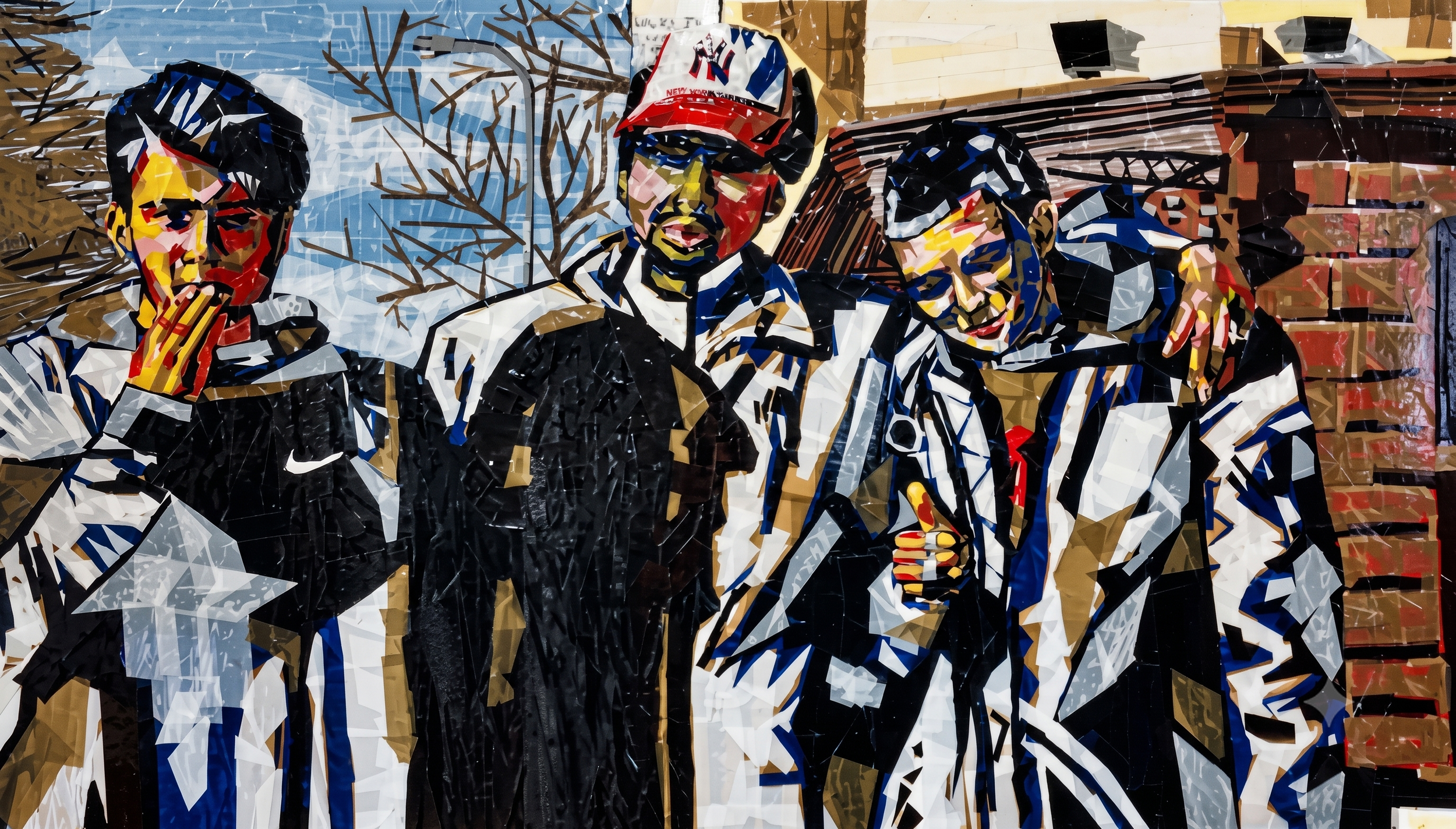
Tape drawing - Gaby Grant
Mel: Yeah, I'd love to see that. That's really interesting. And that's like and that I mean, for you, that's the sort of that's the pretty picture because it's not the trauma that you've experienced. A nice memory.
Gaby: Yeah, a bit more traditional, like feels skill based rather than message based. Feels like I'm doing something with my hands and I'm thinking about the placement and this and that. And I feel like I'm tapping into like a manual skill rather than trying to say something necessarily.
Mel: I’ve never I must say the link that you've made with advertising and conceptual art is really obvious now. And it's I mean, it is really obvious, but the way you describe it and the way it's you've been influenced by the you know, all the all those artists of the nineties who I when I went to college, they were I went to see Sensation as well, and so I was like an older person. At the time I was kind of I don't know, I wasn't really I wasn't a conceptual artist, I went to art college as well. And but I got it and I thought it was really awesome and very honest as well. But I guess, yeah, advertising is so much about getting a message across and emotion. And I can see the link is obvious. But how does the art, the conceptual work that you've done, does it help your work? Or do you have to dumb it down? Because you can't be as personal with it. Does it work? I mean, do you enjoy it? I mean, you probably have to say yes . But I mean, as a sort of as a process, have you know, try to get a message across that isn't necessarily yours, but still be emotional about it? Do you still enjoy it?
Gaby: I never knew advertising existed until I got into it. So it wasn't like I was like dreaming of it.
Mel: No one does, everyone just falls into it.
Gaby: Yeah. But I when I started doing the School of Communications course, which is the advertising course, I did before working in the industry, I actually had no idea what it was. Like, I just thought it was really cool that the interview process was like, sell yourself for four minutes. And I was like, oh, that's cool. Like, I'm sort of a bit, what’s the word, an extrovert. And it appealed to me, and I liked that. And I thought, oh, if someone's offering such an unusual way of interviewing, it must be somewhere interesting. And everyone, once I got in, everyone's like, ‘what just what is it that you're studying?’ I was like, Not quite sure. I think it's like communications, and like the director's really quirky and weird. And I don't think I was quite sure what it was for quite a long time. And then when I did sort of finally realise, I had the realisation that conceptual art was quite similar.
And then I thought oh, great, like, I can get paid to come to come up with ideas. Like, that's that's great. Like, I kind of originally was like kind of practically just thought, oh, like I'm never going to make any money as an artist. And in this way, at least I can put some form of art out there and it will actually be seen by the masses. Not just that, but I was quite overwhelmed with the idea of being like lonely at the age of like 21, of like being an artist on my own, like sitting in a studio every day on my own was not appealing like at all.
And so the idea that I got to like work with in a team or obviously I work in a partnership, which is even more intense than a team. in a partnership, in a company, getting paid to make ideas. Just thought, I just thought, tick, tick, tick, like great. Originally, all I wanted to do was a charity work, because the charity work that I saw originally was all the sort of things that were closer to art and were a bit more shouty and were less selly. Let's say, because I'd never had it I didn't, you know, necessarily care that much about selling anything. And that sort of came later, that sort of, oh, cool, you could do a really funny script for Twix. And that's actually like, you know, a form of script writing that teaches you about humour and comedy. And you know, that in itself is an art form. But at the time, I knew so little about advertising. I didn't see how I didn't know or understand that that was like an art form, so to say. And so I thought at the start, and I hope this doesn't get me in trouble, I thought I was selling myself out a little bit for advertising. And I was like, shit, have I just given in to the man and given up my dream? But then the more I learned about, you know, the more ads I watched, 'cause I hadn't really watched many ads, and the more I understood behind them and how the scripts were written and looking at some of the best ads, you know, like the Snowplow Volkswagen one, which is, you know, the one of the all time most talked about ads. But I thought, wow, like they're super smart. And like, there's so much craft in them, and there's so much art in them. And I, you know kind of understood it more and felt more drawn to it. But my art practice at the moment feels quite separate to work. And I I did a.. I’m in a course at the moment with Adam & Eve, which is great about just like a leadership course, and it's teaching us about things. And like one, we had a values workshop, and one of the things that came out with that is that I wanted to make art, and she said, ‘well, why can't you do that in your job? Why can't you make ads that feel like art?’ And I sort of thought like, look, not always achievable, but like, you know, because of clients and things like that. But if you if you strive for that, then you're more likely to make ads that look like art, even if it's hard. And I think that's been something that um..
Mel: Can ads be art though?
Gaby: Can ads be art? I think some can like… I don't know if you saw the Adam & Eve Missed Birthdays exhibition. It wasn't done by us, it was done by another amazing creative team by Jay and Forrest. That was, you know, all thousands of balloons in Westfield. And if it is totally art, like you can't deny it, even though it's getting a message across, and in a sense, it's advertising a service which is CALM. It's totally art. Whether you always have an opportunity or the clients to let you make something like that or the desire to make you want to make something like that is different. But I do think there is the opportunity even if it's scarce and rare. I think like to answer your question another way, I got to a point after really getting to like me and Jane worked really, really hard to get to Adam and Eve and to establish ourselves there and to, you know develop, you know, a good reputation with, you know, our bosses and to get some work out there that's hopefully half decent. And um I forgot what I was going to say now. Oh, I remember. And I sort of denied myself of my art in the process of doing that, which sometimes you have to do, you know, you have to focus on one thing, and we want to get there, and we want to get the job, and we, you know. Strive, strive, strive, strive, strive. And luckily it paid off. But then, after, it wasn't until sort of like the end of last year, so a year ago, where I realised I was deeply unsatisfied if I didn't have my art practice. It will I don't know if this is okay to say, but I guess advertising isn't enough for me to just feel fulfilled in making art. I need my own outlet in order to feel that I'm making art.
Mel: Yup, I understand that. I think advertising can be art. But it's not necessarily yours.
Gaby: No.
Mel: And yeah, to fulfil that need to process and create for yourself, it's very different. It's a very, very different process, isn't it?
Gaby: I also think there's a dangerous thing about putting yourself in ads. Like, you know..
Mel: If you’re putting too much of you and your past or your personality or..
Gaby: Yeah, I think like, I don’t know. Because you don't own it, as you said, and because you can't control it, and there's so many voices like I'd love to take some of like the ballsiness and the guts and that and put it into you know advertising. But putting myself in or like, you know, put like even obviously not me, Gabby Grant, but you know, like a an experience and putting it like that would be scary, you know, because then you you've got no real control. At least if you do it yourself and it's on you, the consequences are on you and it's everything is a decision you've made. So I feel that maybe other types of artists can put a bit more of their art into the advertising and maybe there's more crossover, whereas mine at the moment feels quite far apart, I guess.
Mel: Like, okay, so how about if you, I mean, you, your tit um, my tit your tits are mine. My tits are mine. Um..
Gaby: These Tits Are Mine.
Mel: These Tits Are Mine. Sorry! Brain freeze. These Tits Are Mine. You wouldn't would you ever put it like give it to a brand or any brand or a charity or something like that? Would you is that something you could give up? Because it would be giving up, wouldn't it?
Gaby: I think like I've thought about that a lot, and I'm not really into like make you know, if I if if I being a successful artist in inverted commas was making money, great, but I'm not really in it at the moment to like make any money. And I been thinking a lot about when I've obviously just launched my business and like obviously launching a clothing business is tricky, but even more so tricky when the product is personalised. Each t-shirt is custom made and hand printed by me, and I'm a one-woman show. And the idea of, you know, giving hope, giving people trust in me to send them, send me a topless photo of themselves is obviously something I need to earn and not something that is going to be just given to me just because I say I'm trustworthy. And after a lot of thought and just through the making of it, I've come to the conclusion that each piece, each piece I make is a custom art piece for someone. And so the idea of giving that to a brand doesn't make sense because they wouldn't be able to give that experience to the women that I'm you know, or not just the women, potentially, anyone who's had a naked picture spread of them, to that level of trust and that level of intimacy between me and that person, because ultimately you are sharing something really personal and putting hoping that and trusting that you know I'm going to look after them, which I will and am.
You know, I'm not the first to put boobs on a t-shirt. Obviously, Vivian Westwood did it, and she's, you know, the brand is re-advertising it. So I'm definitely not the first. But I don't think any I don't haven't seen anyone do it on a mass scale with custom orders. And I think that's what makes the brands unique and what It's not just about putting the female, uncensored female body out there. It's about giving women the opportunity, whether they've had this experience or not, or whether they just feel shame about their body or they're embarrassed about their boobs or they love their boobs, or however they feel about them, to say, ‘yeah, here they are, and I feel proud, and I, you know, and I've got a piece of art that makes me feel proud every time I wear it and gives me back a sense of ownership and empowerment over that. So I think a brand just couldn't deliver that personalised experience.
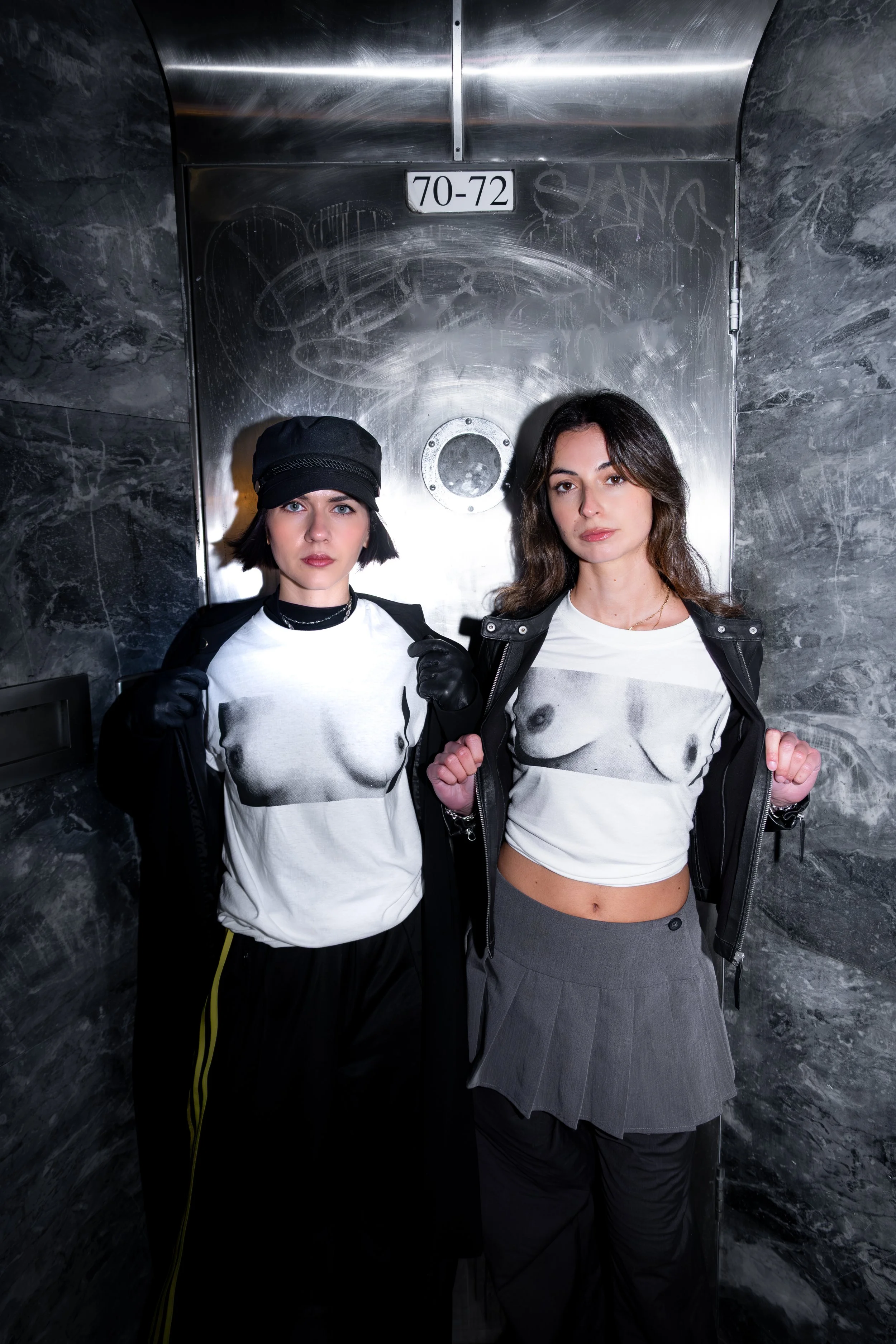
TTAM collaborators
Mel: I can imagine. I mean, the meaning is lost.
Gaby: Exactly.
Mel: So, yeah, no, I'm glad to hear that. And I can see, I can understand that there it's such a personal thing. But it's interesting to have that conversation. Because maybe there is an idea that you have, as they say in your bottom drawer, where it's something you want to make, but it might be perfect for a brand. Would you give it up? Something that you want to make as a as a personal art piece that something's been bubbling away. But a brand came and you know, there was a brand, there was a brief and you thought, ‘oh my god, this would be perfect’. Would you think it would feel like you were selling out? Or I mean, would you do it?
Gaby: I really think it like would really depend on the idea and the client because you know, once you give that idea, you don't own it anymore. And so, really, anything can happen to it. So, I think, like.. there was a.. we were working with a breast cancer charity last year, and it did cross my mind that something like putting boobs on your t-shirt would be something that would work for that. And the last t-shirt I made was for someone who just had an operation and to remove a lump. So it like, you know, it's not that far. I can't remember now if I maybe did add the idea in some shape or form. It wasn't sold. But I don't know. I think that.. I think at the moment I'm in such like a particular part of my art where I'm really set on these projects. I'm writing and finishing my book. I'm starting These Tits Are Mine, and I'm also working towards my own first solo exhibition called Unclothed.
Mel: Tell me all about that.
Gaby: Yeah, it's really at the start of it. And I actually just by making the artwork, sort of going to figure out the message, but it's sort of like, at the moment, it's like a love story between me and my partner, but told in like explicit slash explicit imagery, but with really witty, hopefully witty titles. I can't give too much away, but
Mel: It sounds like a love story.
Gaby: Yeah, it's like a sort of unfiltered, witty, explicit love story.
Mel: Sounds gorgeous. That sounds gorgeous. And sounds very different from your other work.
Gaby: Yeah, it is a little bit, but I'm really excited about it. So, yeah, I think there can be art ideas. I don't think I'd give any of mine in my own projects to them. But I definitely, if the brief was to come up with an art piece, I would definitely ideate in that way and I wouldn't keep it for myself if I if it was appropriate and fitting for the project. I think right now I wouldn't give anything that feels like mine away, to a brand.
Mel: No, I understand that. I totally get it. It's funny, advertising is a bit icky if you've been to art school. It does feel like a little bit of a sellout. And when I first started in the industry and I was just doing sales and I don't know, I've always I kind of apologised, especially to all my other art friends. But you find your way. And it's my way.
Gaby: Just to be clear, I don't feel like a sellout now. I know. I love my job. Yeah, I think at the time I was like, as you say, it's more of like the unknown, right? Like you feel. You're so.. at art school you're so righteous, and you feel you know, when you're young, you feel like everything is possible. And I was like, I'm gonna have my exhibition at the Royal Academy, I'm gonna be a famous artist, and everything's gonna be fine. And obviously, you know, that naivety fades and confidence. And, you know, I think that yeah, I think you're just very brazen when you're young and you say things that are like..
Mel: I think, and then reality hits you. Yeah, and you do think, oh shit, I've got to pay the bills. But what I think is amazing about advertising is that the longer you work in it, the more you realise almost anything is possible. And it gives you incredible contacts for yout o create your art if you wanted to. I think it kind of puts you in touch with so many companies and people who can expand your world. So if you were to I don't know, if you were to do something if you were to.. if you wanted to make something en masse, then you could, couldn't you?
Gaby: I also things feels like I've really developed my skills like as a copywriter, as an art director, as an ideator, as a, you know, sitting behind the camera, giving you know, a director. And obviously, I'm not directing, but you are directing, you know, a little bit when you're saying, I like that shot, I don't like that shot, I want it to be like this.. editing and colour and sound and music. And we're very lucky as creatives that we get to see those projects all the way through and that we you know, our job can change depending on what part of the project we're in because we and you know, sometimes we're account people because we have to figure out how to set our idea in a little bit. And sometimes we're strategists because they ask us to crack the platform idea, which is strategy and I think that it's developed my skills as a communicator, but also as an artist in ways that I couldn't have foreseen. I feel really grateful for that and only hope that I can learn more. And I'm curious to learn more. And I want to go and you know, maybe do a course in creative writing and see if that you know, because I come from more of an art director background and see where that can take me. And I feel really yeah, I feel really privileged that I work in an industry that is creative, that I do get paid for and that I really enjoy. And the most amazing thing about working at Adam and Eve is the opportunities as well. You know, work for some of the biggest brands in the world. And with that comes the possibility to potentially more opportunities to make art.. make ads that feel like art. Because I think you're not somewhere that doesn't have those opportunities then sometimes you just have to do your job. And I feel that actually, it's very open at the moment. It feels like it's very open to anything, as you say, that if you had any good idea and then people back it, they'll find a way to make it, which I think is amazing.
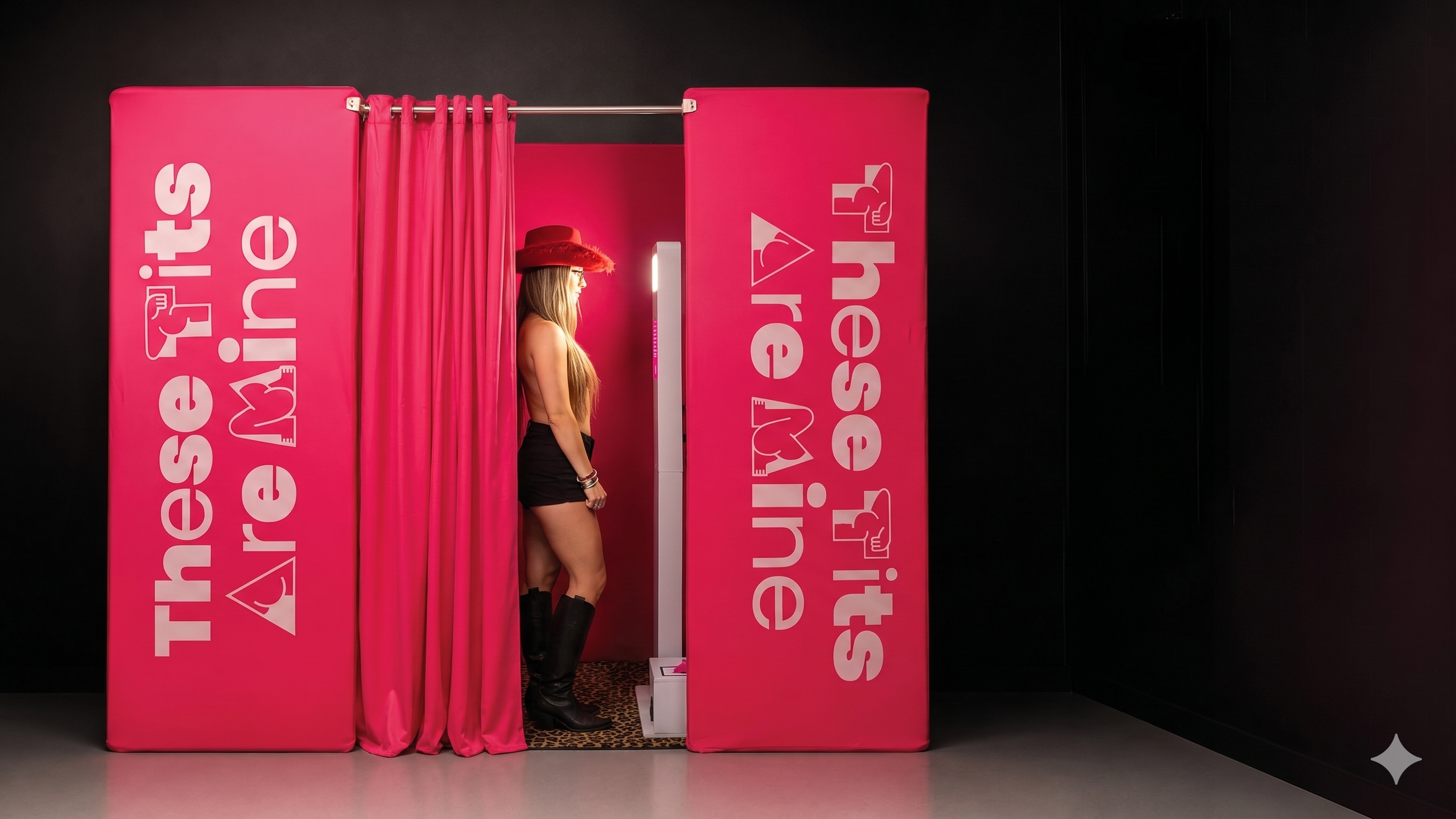
TTAM photobooth