WENDY MCBRIDE
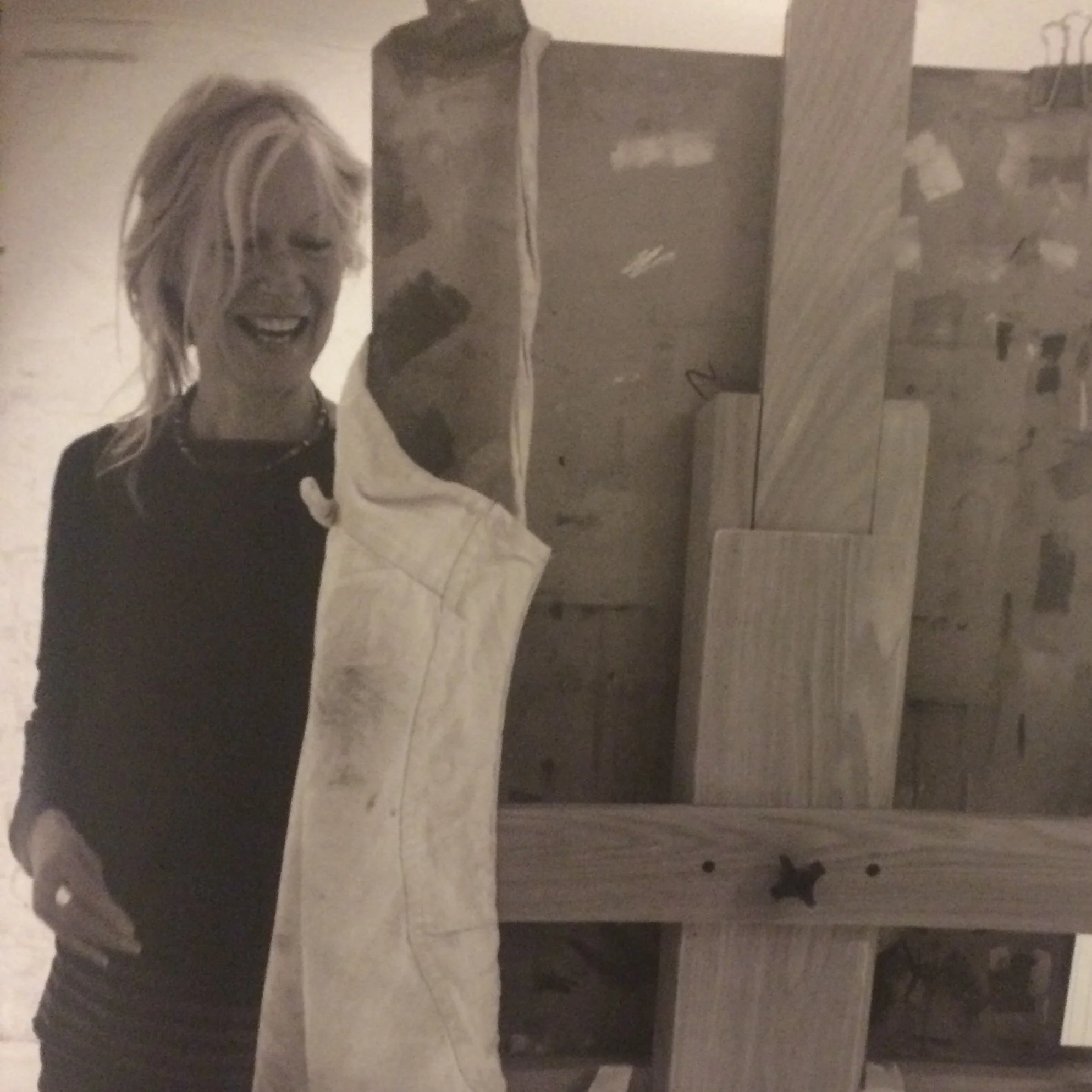
Wendy McBride
Welcome to another Other Ways of Seeing conversation. A podcast about the art we make alongside our already very creative jobs. An investigation into why we feel the urge to make that art. Or for the artist I will be talking to, the urge to make different work from what she’s known for and what she sells.
This conversation is rather special because it’s with Wendy McBride my mum-in-law. She is a successful artist in the South West of England drawing inspiration from her home in Devon and Dartmoor, all the way to the Isles of Scilly. Working mostly in pastels Wendy paints landscapes which are sometimes representational and sometimes not so much. In her early eighties you’d think she’d got her practice down, sorted.. but as with many artists, she struggles with what she wants to make and what she feels she should produce for her audience and the galleries that represent her. Commissioned versus non commissioned art.
We begin our conversation talking about Jude, her grandson who is an incredible drummer. Wendy’s love of Jazz and how that fits with her relationship with abstract art. We discuss the influence of her childhood, growing up alone in the wildness of Anglesey and drawing in books in wartime. Wendy speaks about how she first started selling her work in the Scillies after being encouraged by her husband Keith. We talk about how some of her earlier work didn’t sell because it was ‘too abstract’ but needing to sell to supplement the family income and how that changed her work. We chat about her most recent solo show at White Space Gallery in Totnes. Wendy explains why painting pretty pictures is not enough anymore. We talk about compromising quality for cash and we touch on Wendy’s poetry. We end with advice for aspiring artists and look to the future of her art.
A little word about our sponsor hungryman… hungryman is a global production company with offices in London, New York, Los Angeles and São Paulo. Known for pairing high-end craft with a distinctive point of view, hungryman’s work spans blockbuster spectacle, sharp comedy, and emotionally driven storytelling. And here is where it gets interesting in terms of Other Ways of Seeing.. beyond commercial work, hungryman’s advocacy arm continues to expand the role of storytelling in culture. Across its two art activist ResistDance films and live performances, the large-scale dance protest project generated more than 100 million views, reaching 1.5 billion people across nearly 100 countries. Mind blowing. At the same time, hungryman’s growing entertainment division is developing a slate of films, documentaries, and stage projects. And hopefully we’ll be diving into those art projects here at Other Ways of Seeing soon.
But now, back to Wendy McBride…
Mel: So shall we start with the last piece of art or music or film or anything that you've seen that's inspired you, or just blown you away.
Wendy: Okay, well, I think as we were saying before.. the last piece of music was Jude's, which is my little grandson. Not so little now. He's twenty, and he's been doing a course at Falmouth, and he's extremely musical and they did a gig, three of them, down on the river in Totnes. And I was absolutely delighted. He was so good. He's a drummer. And honestly, he was so musical and he fitted in because drums do have to do that with two guitarists who are also extremely good. And I could have sat all day and listened to it, and it was really quite interesting.
Mel: What music was it?
Wendy: It was mainly a sort of jazz, jazz of all sorts really. I suppose I don't know which jazz it was. I think he likes quite old fashioned jazz. He likes Miles Davis and oh, I don't know..
Mel: And this is Jude, this is Jude McBride, your grandson, who is an amazing drummer, and he's at Falmouth in his last year?
Wendy: Yes. And this was in the last holidays before the beginning of his last term.
Mel: And actually he's a drummer for so many different types of music.
Wendy: He went to the Brit School in London, and they were very good and they're allowed to do all sorts of things. And he ended up really with the drumming being his most favourite way of making music. And his rhythm sense is superb. And also, he's not too overpowering. He fits in between the two very good guitarists that were there. And they hadn't really practised, hey’d decided on a couple of songs, but that's about it. And that's really what I thought, goodness, you could you can be so creative within that small genre.. particularly jazz.
Mel: I was going to say, jazz is the one type of music that you can go crazy on. Go abstract.
Wendy: Yes. And the different chords and the way it sort of changed. It was great.
Mel: It’s inspiring seeing live music, isn't it? Whether it's you know, obviously a family member or not, there's something about being in a safe space and getting the music and experiencing it live.
Wendy: I started off when we lived near London and I was taken to The 100 Club. Where it was down in a cellar.
Mel: Is that the famous club?
Wendy: Yes. And that was my first introduction to music and to strange noises and hundreds of people all crammed together and all sort of part of it.
Mel: So The 100 Club, for anyone who doesn't know.. was that a rock and roll venue?
Wendy: It was then, but this was jazz.
Mel: Oh this was jazz..
Wendy: I can't remember their names, but there were some quite well-known pianists and well, guitarists.
Mel: I’m going to look this up actually..
Wendy: Yes, do find.. find the names. I can't remember, you see. It was a long time ago.
Mel: Still says it's there. At Century House.
Wendy: I don't know what it was called.
Mel: 100 Club. London's iconic 100 Club. Oldest independent venue worldwide.
Wendy: There you go, yes.
Mel: Okay… So the venue has championed all manners of groundbreaking scenes, including the blues of Muddy Waters, BB King, as well as the mod stylings of The Who and The Kinks in the Sixties. The birth of Punk with The Sex Pistols, The Clash, and Siouxsie and the Banshees..
Wendy: I’d lost it by then because we moved away from London.
Mel: Wow! So like The Who in the 60s and the Kinks. Were you there then? You must have been there then.
Wendy: Yes!
Mel: But more it was more jazz when you went?
Wendy: It was, actually. Well, I think the guy I went with was very keen on jazz. And also he thought it worked for me as well.
Mel: As a genre of music?
Wendy: Yes, as a genre of music, which I hadn't come across before.
Mel: Right. Good date then! You did well.
Wendy: Yeah, I did well. Yes.
Mel: Is that something that you've enjoyed in life, a sort of an abstract take on creative acts.
Wendy: It is. I think it's carried me through quite a lot. I think I recognise things that work, but I like the way they change and you know you follow them through, and they become something else. I mean, that works with art as well, of course.
Mel: Is that how you work? So does your mind sort of abstract things in your interpretation of something?
Wendy: Yeah, well in art it happens as I go along. I start thinking of something or I start remembering a scene or something. Without having anything in front of me. I don't like taking pictures very often, although they're sometimes something to remember, and then put away.
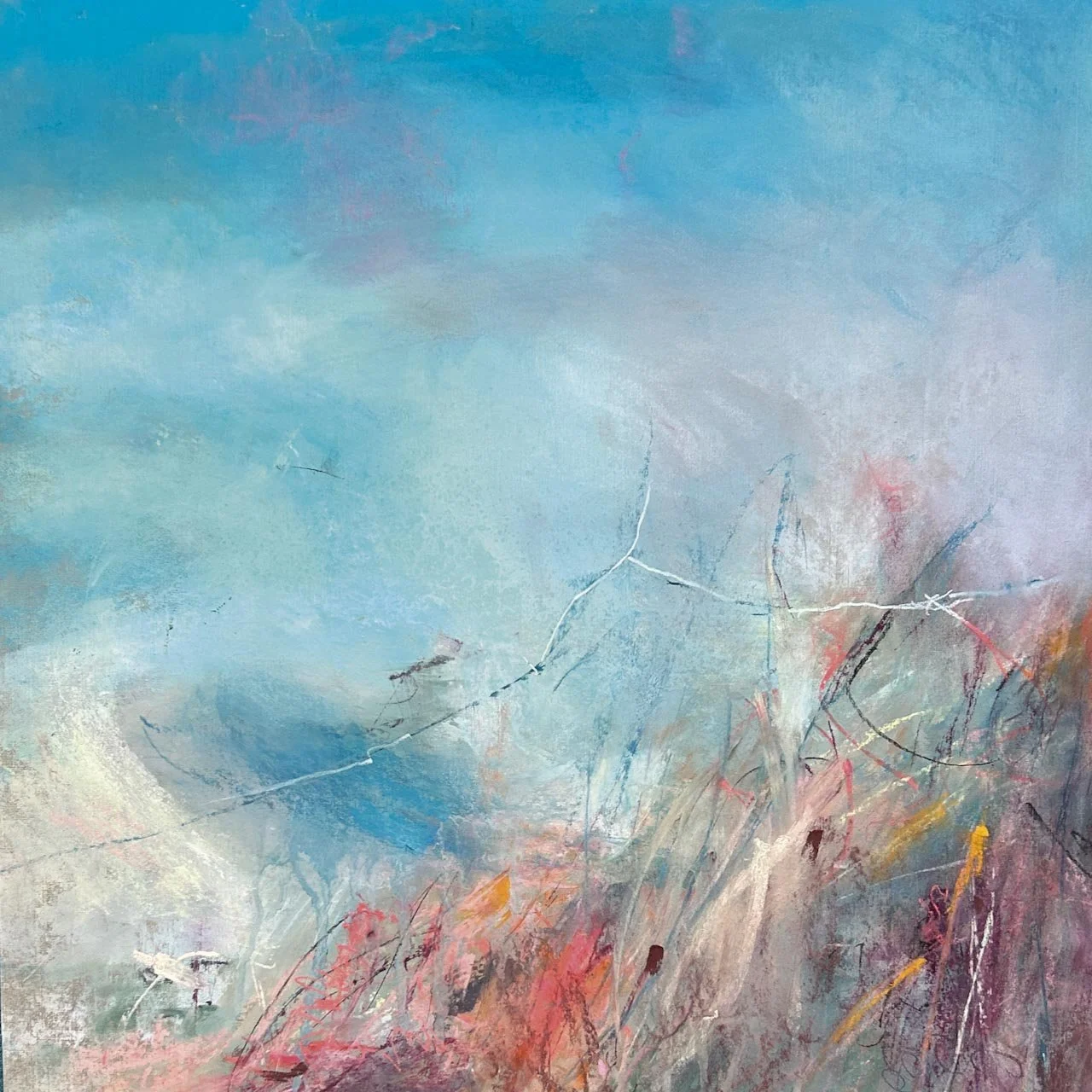
‘Always the Sea is There’ - Wendy McBride. Courtesy of White Space, Totnes.
Mel: A reference.
Wendy: A reference, yes. But yeah, they grow from the first thought really, from not thought, the first way of seeing. And they change usually.
Mel: Are you recreating memories of the feeling when you’re in the space…
Wendy: When I started I did a lot, yes. I was recreating my childhood really.
Mel: Oh, really?
Wendy: I think so, because well, I was born in Anglesey just before the war and I grew up there, till I was eight. So there was nobody else to play with. It was very lonely, I suppose, but I enjoyed it. And the sea was there and it was just wild. And that's what I've really always loved and still do. And it can go into music or anything really.
Mel: That wildness.
Wendy: Yes. And the way that things can change.
Mel: Yeah.
Wendy: Um yes, I suppose in art I've later well we're g we're jumping really, but going on you’d you get a bit stuck with what what you know you can do.
Mel: Do you feel you always come back to your childhood?
Wendy: Yes I think I do. It’s so strong, isn't it? What you've seen when you're little. It was for me, because I was an only child till well, my brother was born when I was eight.
Mel: Right. It's a big gap.
Wendy: It is a big gap. But it was fine. And yes, so I had a lot of playing by myself and looking at things, making things and having little camps in the middle of bushes and silly things like that.
Mel: Oh, it's glorious.
Wendy: Yes, it is.
Mel: I think having that, being able to roam free and and make up games for yourself… I think it's precious. I'm not sure that many children get that opportunity.
Wendy: No, but they don't anymore. Well, I mean, I suppose there was nothing to do in the war, you didn't have any toys or anything. My mother used to give me bits of paper to to crayon on. And I loved doing that. That was great.
Mel: Still doing it!
Wendy: Yes, still doing it. Never stopped. It hasn't changed much.
Mel: I love it. It's still abstract.
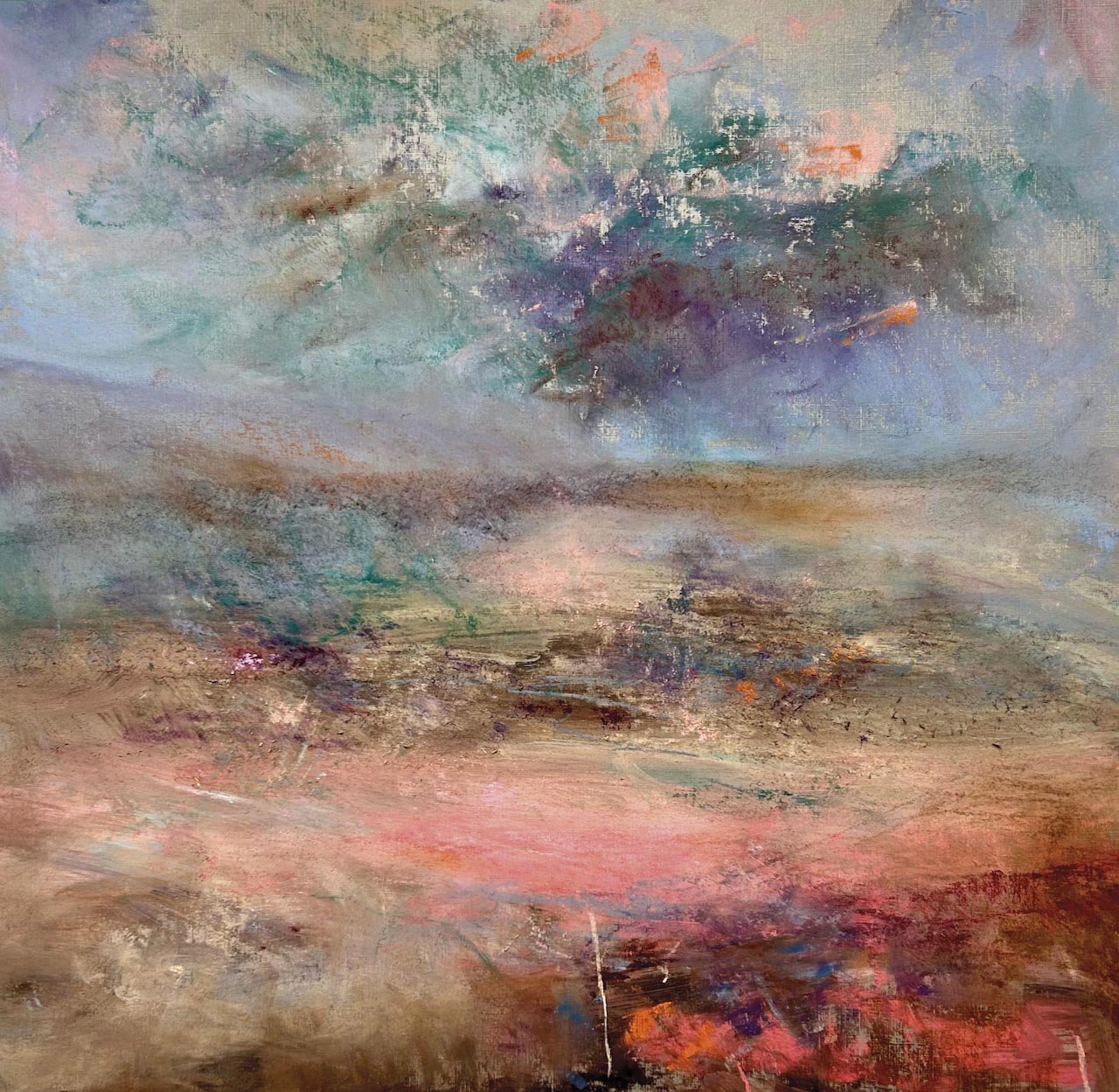
‘Dartmoor Wearing Pink’ - Wendy McBride. Courtesy of White Space, Totnes.
Wendy: See, that's probably why I went to pastels… from crayons.
Mel: Oh maybe, gosh you never know..
Wendy: I don’t know, I hadn't made the link before. But it's possible.
Mel: Yeah, I never thought of analysing that.
Wendy: I don't like change you see.
Mel: Who does?
Wendy: I know, quite. And actually the little books that my parents bought me.. I don't know whether you ever saw the Little Grey Rabbit books and Beatrix Potter. In those days within the book there was always pictures, lovely pictures which are drawn, and then there'd be a gap with plain paper.
Mel: At the back?
Wendy: No, in.. within the book. It was shiny paper and, you know, after the picture, on the other side, there was a plain piece of paper.
Mel: Was that to protect the pictures?
Wendy: No, no, it was part of the book. That’s how they were made in those days. And that was a lovely place to draw and scribble. And at first my mother used to say, “you're going to spoil that book, you know, you shouldn't be doing that”. And then I began to draw things a bit like the rabbit in the book and that sort of thing. But but I remember doing that when I was very little, just having a piece of white paper. Well it was in a book. And there it was.
Mel: It kind of goes against all the things you should be doing, defacing a published book.
Wendy: Yes, but there we were in the middle of nowhere in the war.
Mel: I think it's really interesting doing something like that. I remember when I was at art college finding books that I found in charity shops that I then painted on or drew on. And there was something about it was a sort of a bit naughty, really.
Wendy: Yes, that's right. And if they were drawings, you could colour them in.
Mel: Yes, but exactly, but it was really fun and that turned it into another medium. And something that was little and handheld.
Wendy: And I found if the story was right, I got sort of quite interested in the actual little drawings of the people and what would they be wearing, what colours would they have on. But that was of course a link between reading books or looking at stories and the pictures.
Mel: So how did you become an artist then? What was the journey?
Wendy: I didn’t have a journey.
Mel: Did you not do a degree later on in life?
Wendy: I did, but I'm trying to think how it started. It started in the Scillies actually. Where I used to take a pad just for fun to paint and things because in those days it was very quiet then, there was nothing to do and we'd walk and then we'd sit sort of I don't know, above the beach somewhere. And I sort of started to draw and put colours in.. paint then, I think. And I remember Keith looking at it and saying, “that's really quite good. Go and show Anna at the gallery”. And I said, “oh no”. So Keith plodded along with them.. And Anna said, “Oh, have you got any more?” And that was the beginning. I never learnt..
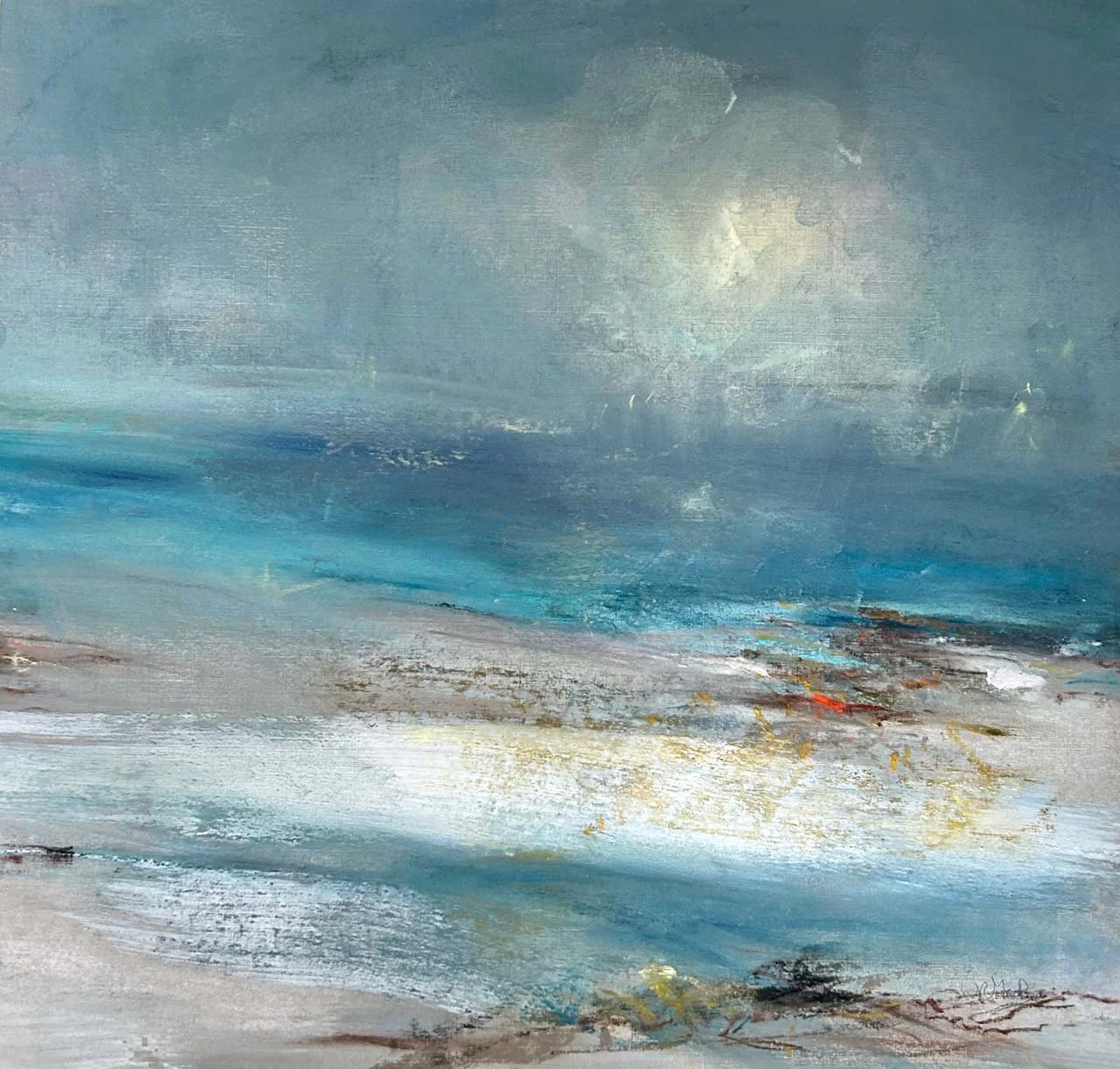
‘Shore Lines. Tresco’ - Wendy McBride. Courtesy of White Space, Totnes.
Mel: Was this when you went on holiday?
Wendy: We went on holiday, with Keith in sort of holiday times.
Mel: With the kids?
Wendy: No, the kids were.. the kids weren’t born.
Mel: Right, so when you were newly married to Keith, even before then?
Wendy: I can't remember the children being there.. They must have been. Perhaps they were playing on the beach, or some of them. But that is certainly what happened. And I know there were only the two of us, because Keith was watching for birds and things because he loved bird watching. And I was scribbling, you know, on a piece of paper and drawing the scene in front of me.
Mel: And you just went to the gallery and she wanted some more of it.
Wendy: Yeah, I mean, she was sweet then, and she was young and just starting the gallery, really.
Mel: Fantastic.
Wendy: I know.. But that was when I thought, oh. And she said, well, have you got any more? And I said, well, no. But she said, well, if you do any more, you know, send them to me. And that was my beginning of sales at Tresco. As my friend always says, you have so many lucky breaks in your life. It's true, that.
Mel: That’s brilliant.
Wendy: Well, it's not brilliant. It's just luck.
Mel: It is luck. I mean, it’s brilliant to have the luck.
Wendy: Yes. I mean, I'd always scribbled and done things but I had some paints with me that time and of course the colours in the Scillies are what really… and the contrast between the white sand and the dark blue sea that I just loved.
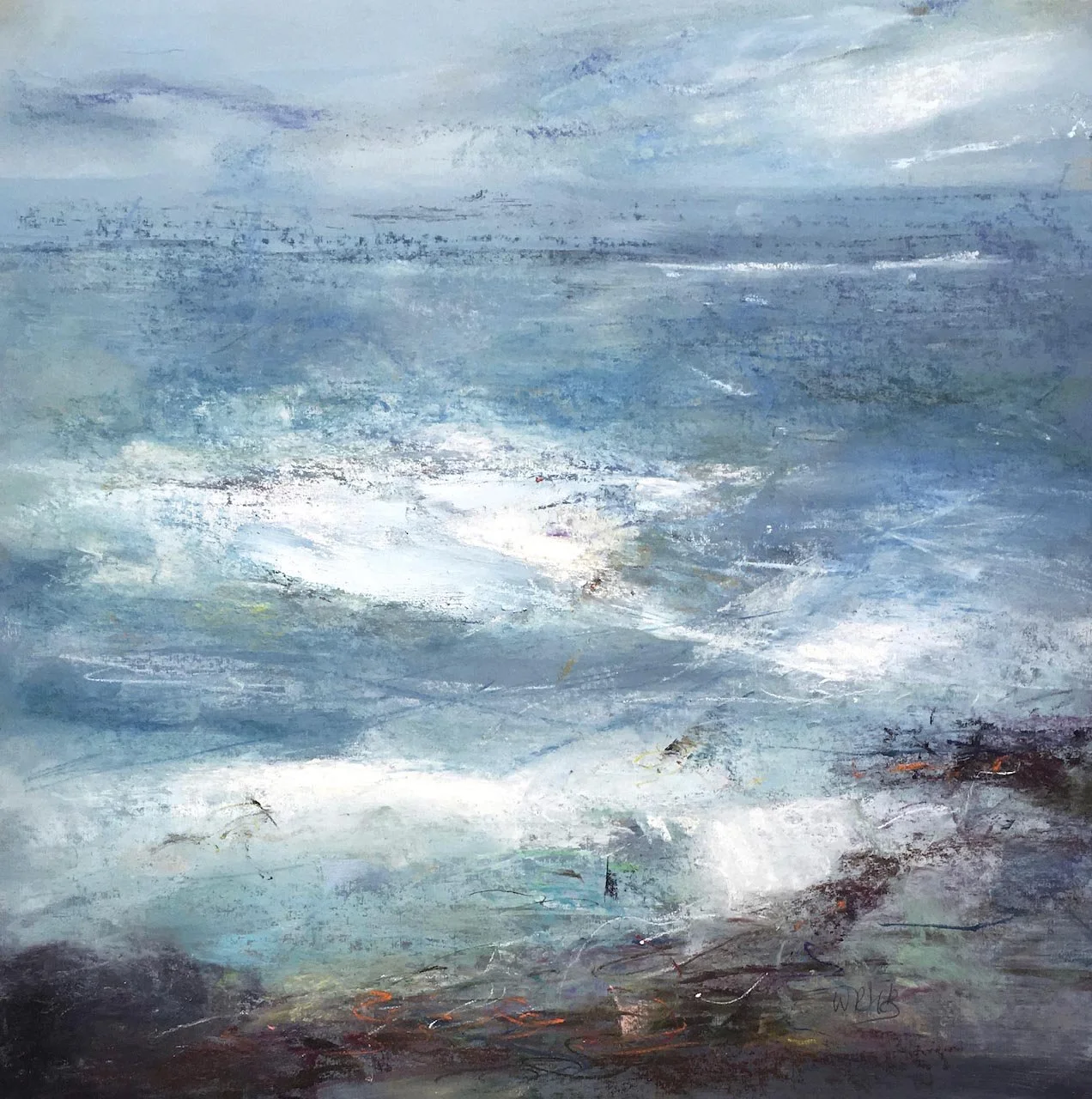
‘Raft of Shags Isles of Scilly’ - Wendy McBride. Courtesy of White Space, Totnes.
Mel: It’s so dramatic, isn't it? But I guess it was Keith really who said let's go and show the gallery. Otherwise it would’ve just stayed in your sketchbook..
Wendy: Well it wasn't even a sketchbook really, it was just paper.
Mel: I love it. And so you've had that relationship with the Scillies..
Wendy: I started by selling there, yes, in the summer. And then she began to ask certain artists over there to stay in the winter when the houses were empty. And yes, for a week here and there. And I got invited and it was just brilliant.
Mel: It’s like a free holiday.
Wendy: It was. Amazing. It was. And that's gone on ever since, almost.
Mel: It’s incredible.
Wendy: I mean, I haven't been lately, I haven't been for a couple of years, but I have got an invite over for February. I tend to go I meet another artist over there usually, who lives up country somewhere in Sussex, I think. But we stay in different houses and just because we do actually we do quite similar work. We what you do in the Scillies, don't you?
Mel: And do you think the landscape is very different in the summer to the winter? And is it better maybe in the winter?
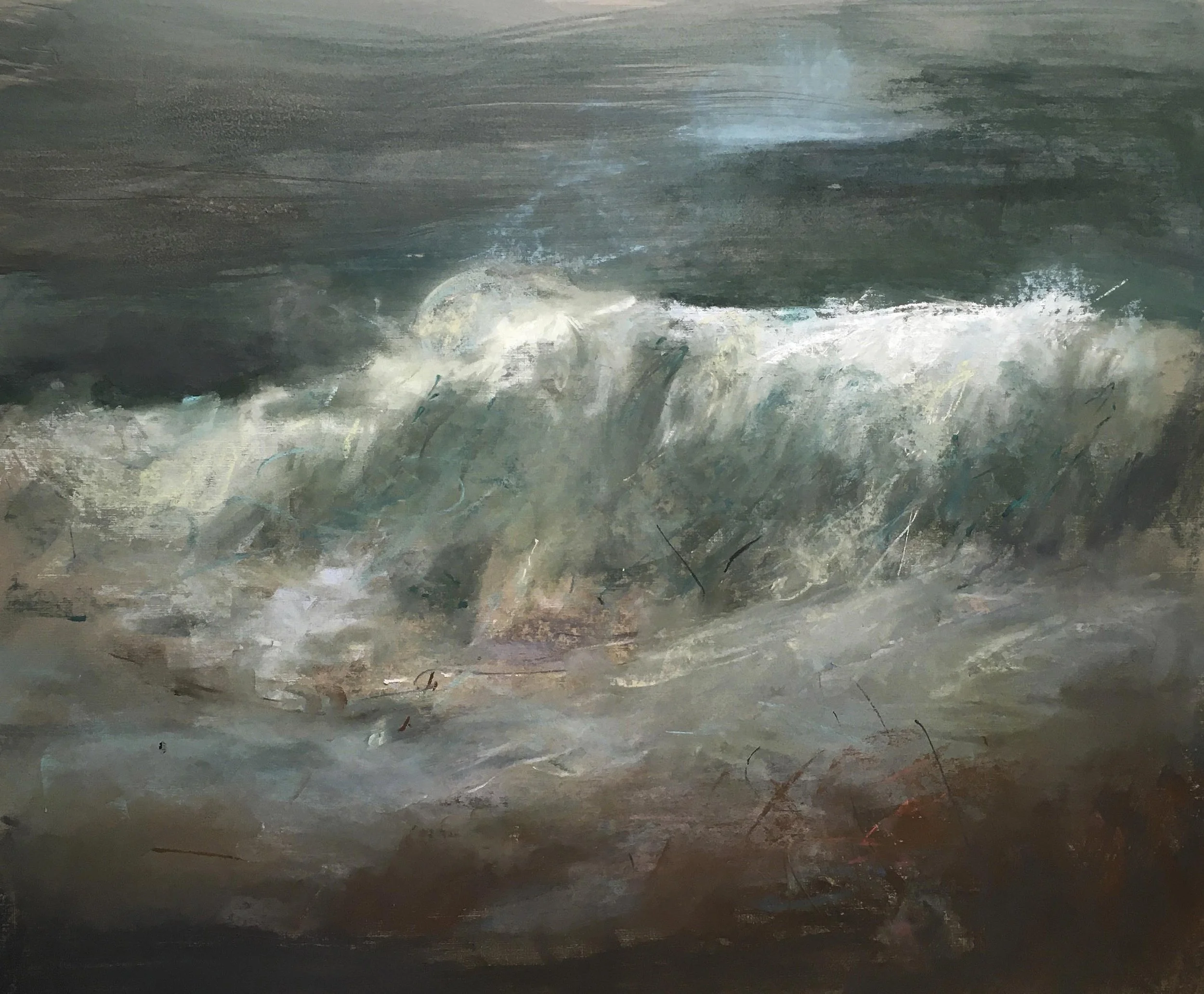
‘The Sound and the Fury’ - Wendy McBride. Courtesy of White Space, Totnes.
Wendy: The colours are different. Colours are different. Yes, in the summer there's a lot more leafy things, but it's still quite stark really. You know, big wide beaches. Well, you know you've been. But I think what attracted me to do it in the first place was just the colour. I mean, it's a Mediterranean, the sea sometimes there.
Mel: A bit colder.
Wendy: It’s certainly mighty colder! My goodness, it's colder.
Mel: Yeah, it's turquoise sea or even like this dark blue..
Wendy: That's right. And you have sort of between the islands is quite shallow. So you get these greens and the brown of from the seaweed, you know, it's wonderful contrasts and things.
Mel: Yes, we have a picture of yours in the living room, which is just that. It's very white. A bit of brown. Blue..
Wendy: Yes. That's right. Yes. Well, that's Scilly. Although actually some of Cornwall is a bit like that, isn't it?
Mel: Oh, definitely.
Wendy: They're not far away from each other..
Mel: No, I mean, it’s very similar to where we live because the Scillies aren't that far away. But there is something about the Scillies, and I think it's because they're such tiny islands..
Wendy: Yes, it's so shallow with not quite so much wave interference, or more..
Mel: Yeah, that's right. At the edges. And it's very calm in the middle. There is a painting we have as well in our bedroom, which is which I've always loved, and it's very abstract. And you can just about make out perhaps that there is an ocean and an edge of a beach and sky. And I've always loved that. And I remember you saying, well, maybe you said to Woo that it was something that didn't sell because it was too abstract.
Wendy: I know. That was quite a while ago when I did do more abstract work, but yes, people like to see the place they've been in. And if you're selling something in the Scillies, these people are mostly holiday makers, and they have a lovely time, but they want a memento. They don't actually want an abstract picture. And I suppose I got pulled along. And because in those days it was quite nice to have a small income, because we were quite hard up. I mean, Keith was starting out as a GP and things, you know, we were hard up and we were trying to pay for the house and things. And yes, so I suppose it was money and wanting to sell, which isn't quite what it should be, and not how I started out, and not how I ever meant to be. But it happened. And much later in life, like now, I look at my stuff and I think, no.
Mel: Really?
Wendy: Yes, because it isn't abstract enough. It isn't. It's too positive. What's the point of it? You might as well take a photograph. I mean, I can do that, but I want more life in it, I want more. And I think that way becomes more abstract. You know, I like places when the wind's blowing a lot, and you know, there's bits on the ground, and I've quite I suppose fairly recently done sort of grotty old hedges and things that are sort of half dead because the colours and the shapes are very abstract. Anyway, I'm going on a bit..
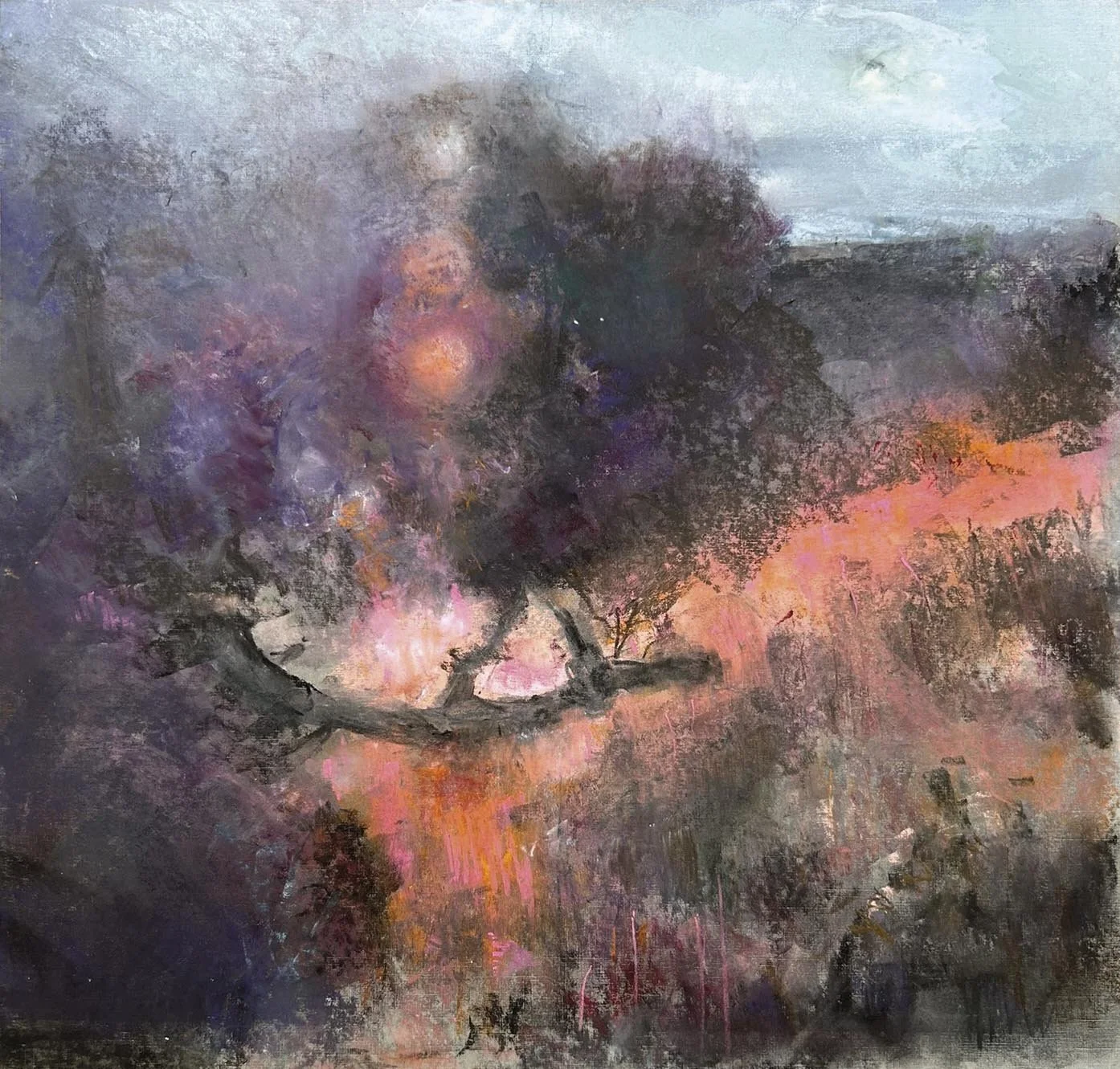
‘Sundown’ - Wendy McBride. Courtesy of White Space, Totnes.
Mel: Oh no, no, I love it. It's a bit like your.. you had a solo exhibition a couple of years ago in a gallery in Totnes. what was it called again?
Wendy: The White Space.
Mel: The White Space. And I remember you being a little bit worried about selling anything because it was before you'd had your cataracts done. You couldn't really see. You had to produce all these pictures for the gallery and you were stressing out, and then you basically sold all of them.
Wendy: And that is why.. because they were recognisable.
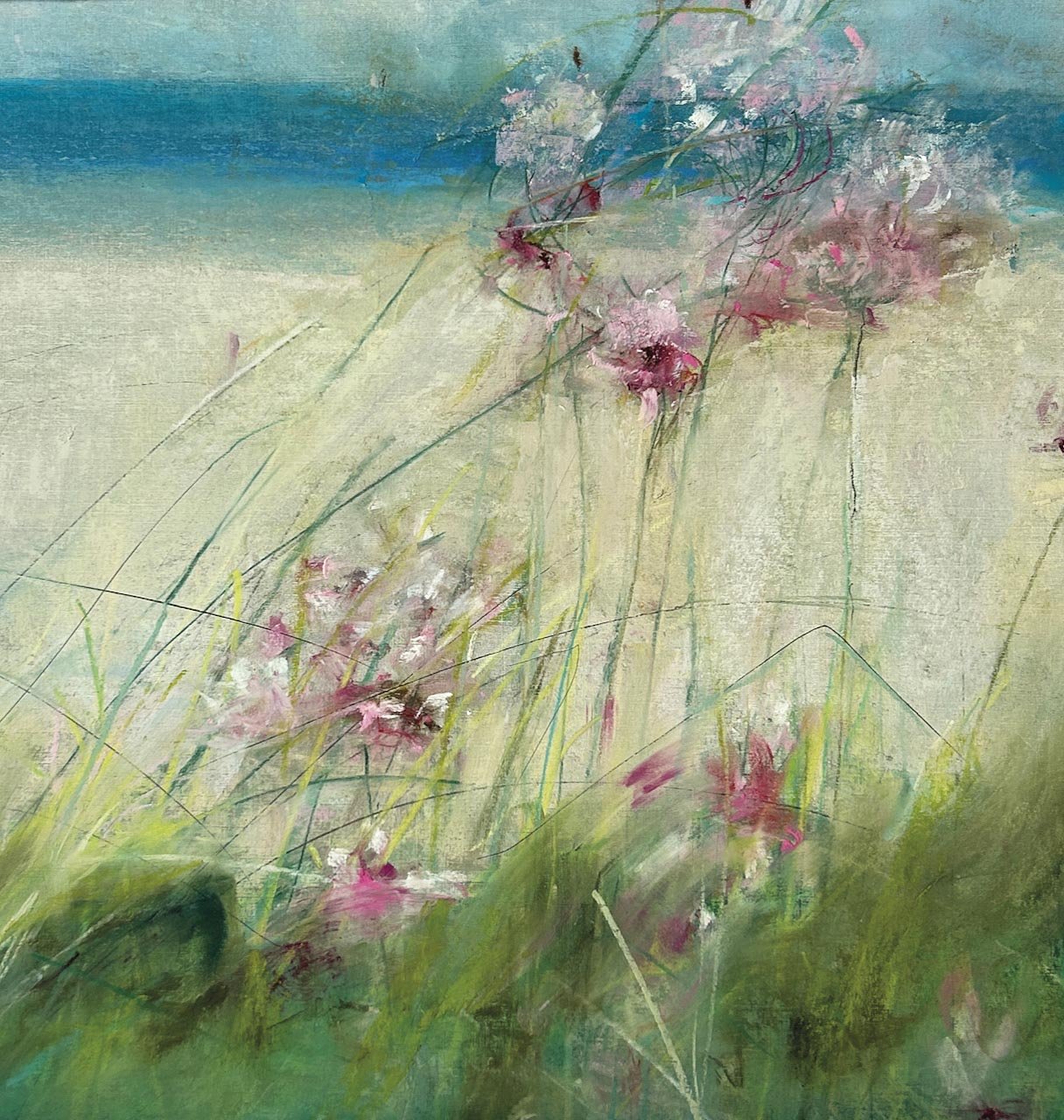
‘Flowering Rush. Hayle Estuary’ - Wendy McBride. Courtesy of White Space, Totnes.
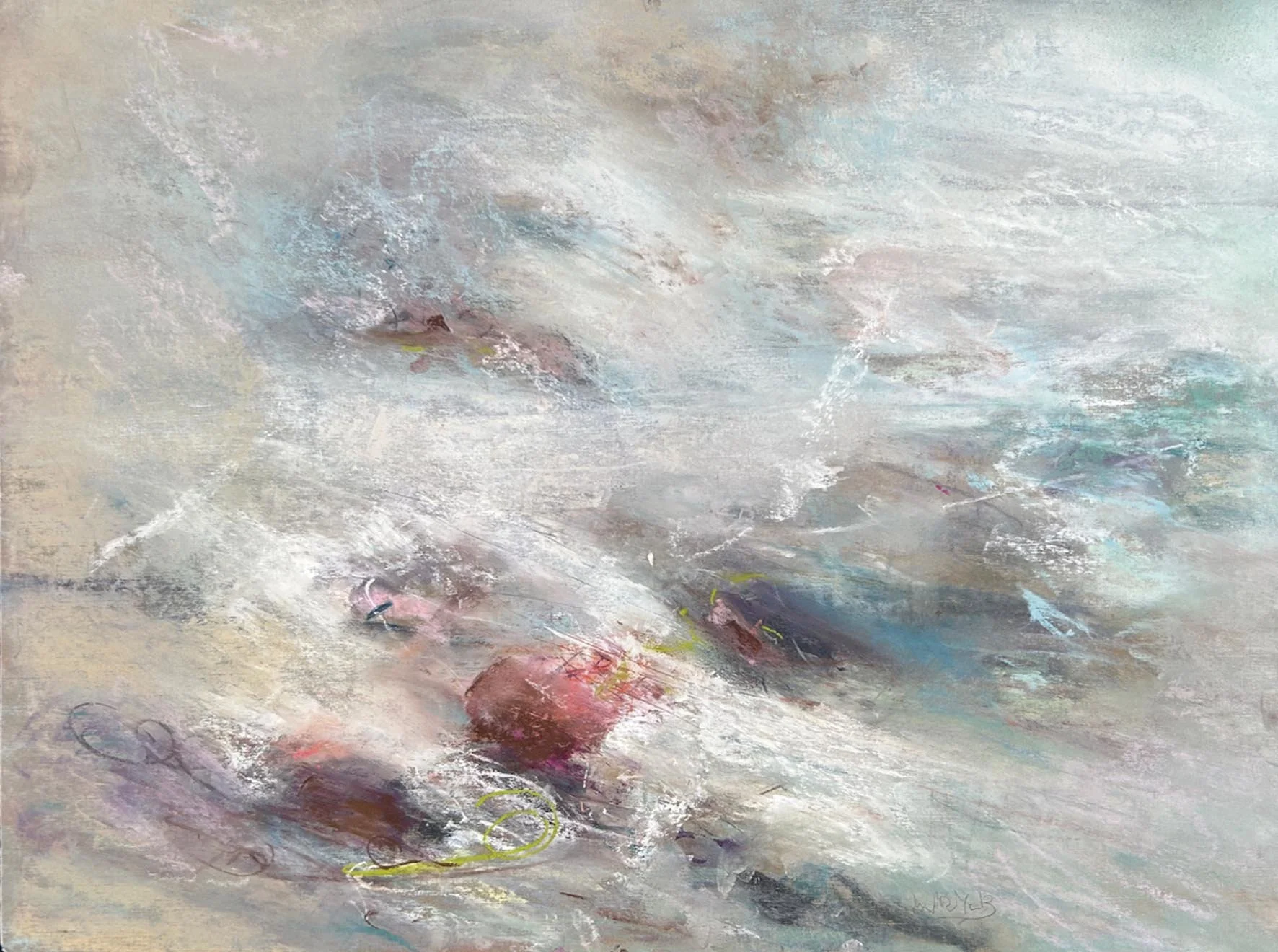
‘Sea Fever’ - Wendy McBride. Courtesy of White Space, Totnes.
Mel: Do you think so? I thought they were less recognisable than some of your other work.
Wendy: Well yes, obviously, because I've tried to be a bit more abstracted and well, not tried exactly. I mean, I am a bit more abstracted. But as you pointed out, the picture you've got in your bedroom, I mean, that was a very early one. So I started being fairly abstract. Actually, looking at that, I think that's what I would need to be doing now.
Mel: Yup. I think so.
Wendy: And it's very difficult to get back.
Mel: It must be very hard. You've been painting for other people for so long.
Wendy: Yes, I have. Yes. And once you've got a gallery and they know your work and the people come to see your work and to buy it, if you're lucky. They want more of the same. They really do want more of the same.
Mel: I’m sure. And I guess there is a form of satisfaction, selling work. Because it's you in a way. It's an interpretation, but it's not your art, but it's still satisfying having someone accept it and pay you money for it.
Wendy: Yes.
Mel: So that's great.
Wendy: Yes.
Mel: But it's not..
Wendy: It’s not quite as satisfying as I'd like.
Mel: Yeah, well, yeah, that's really interesting to hear.
Wendy: Yes, and I've done a lot more stuff that that I don't give to galleries. And I've actually I have I've thrown most of it away, but I am still in my heart wanting to be quite abstract and in fact very abstract. I've gone more about shapes and.. But then you see there's the thing about art is you can't just do pretty pictures really, not forever. I think most elderly artists, as I am, want to change. I mean, the two groups I belong to, a lot of us are sort of.. some of the guys are retired from, I don't know, running schools and things. And they they're starting off being abstract because that's how it is now, I think. And people are beginning.. ordinary people I mean, not ordinary people, people who don't usually buy paintings are beginning to look for things like colour and shape. Do you think? I mean I think so, much more anyway. And certainly the two groups I belong to, I've noticed how the art has changed over the last ten years from people doing beautifully drawn and coloured in pictures to you know to stripes and all sorts of things and also to to have a point. There's so much going on in the world. It's difficult to do pretty pictures without some point. You can say, look, look, the landscape is lovely.. I'm talking too much, aren’t I?
Mel: No, that's the point of it.
Wendy: The landscape is lovely and perhaps it might help people look at it, but it stops there. And we're doing so much which is awful to the land. So, to draw some wild, scrubby stuff seems to be a good idea at the moment, which is back where I started really.
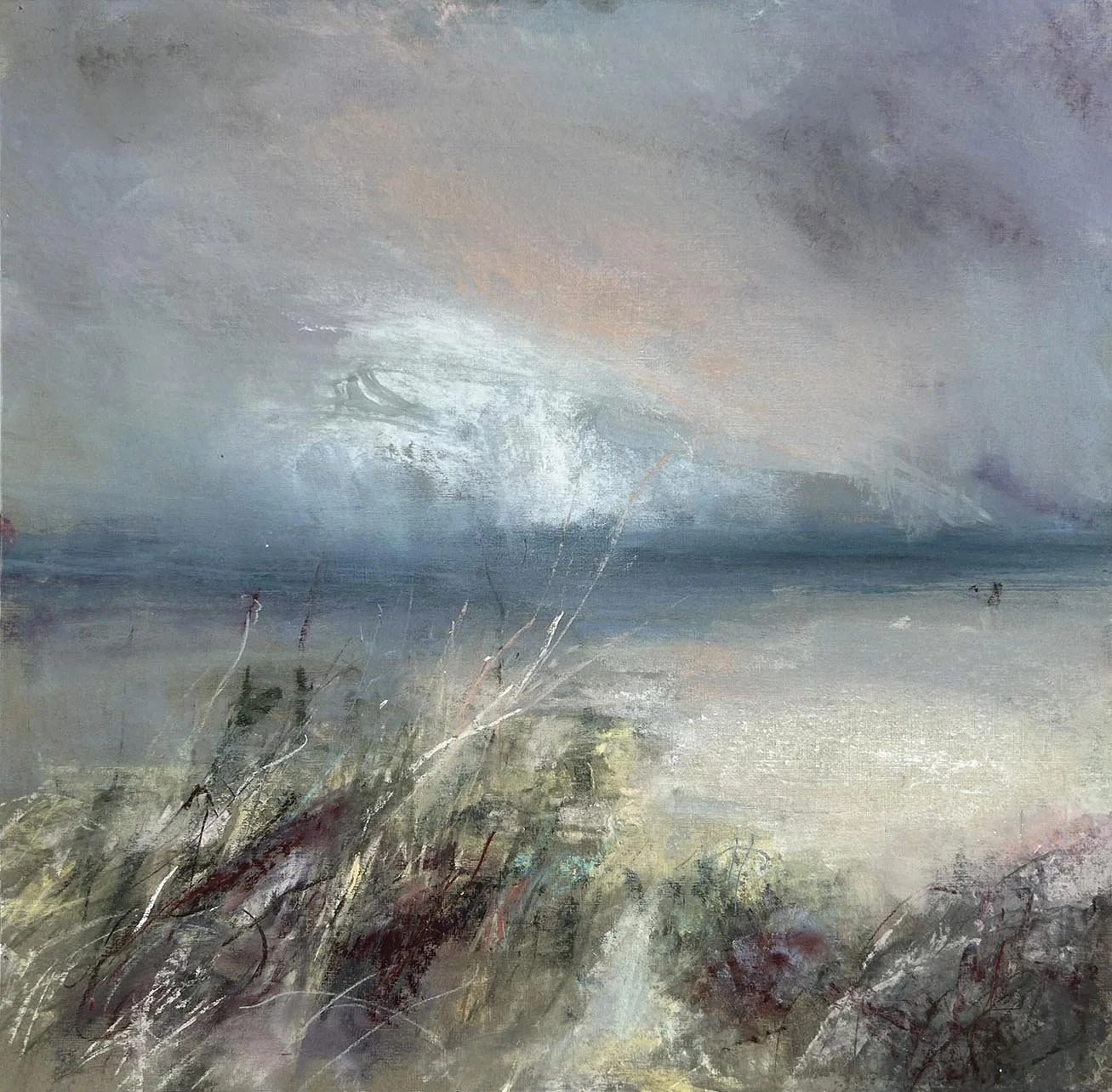
‘Michaelmas’ - Wendy McBride. Courtesy of White Space, Totnes.
Mel: To see the beauty in the darker parts of the land, of the earth.
Wendy: And the edges of things, and the edges of a field which had too much done to it, and hedges which are clipped. And then the wildness, particularly of Dartmoor, of course, because I live near there. And even that seems to be having paths through now where you have to walk and you can't take your dog and things like that. But you can see why.. I’ve lost my track now, really. What I'm saying is you ought.. I feel I ought to be doing something which says something rather than..
Mel: …paint pretty pictures..
Wendy: Exactly.
Mel: I definitely think that the market accepts abstract art more.
Wendy: More. It does.
Mel: It doesn't need anything representational. And sometimes, you've got artists who make representational work that means something else, and then it becomes abstract in a way.
Wendy: Yeah, in a way. And you can either understand it or not. It doesn't matter.
Mel: Exactly. It's conceptual.
Wendy: Yes.
Mel: But I definitely think there is more of a market for that. But are you making work for them or..?
Wendy: No.
Mel: No.
Wendy: That’s why I've sort of ground to a halt.
Mel: Yes. You want to be making work for yourself.
Wendy: Because Joe at White Space said sort of back in the summer he said, you know, can you do some work for October? And no, I couldn't. I didn't know what to do. He understood it totally. And of course he stuck because he knows his market and he knows people come and want various artists that he shows pictures, and that's how he sells them. So it's quite difficult in a small community too.
Mel: Maybe you could make your own art for yourself and then get AI to paint some pictures for you. Some pretty pictures.
Wendy: I hadn’t thought of that one.. I’m not sure I'm up with AI. No… No, what I was hoping to do was slide a few more abstracted ones in among… it doesn't work so well, though.
Mel: Oh, it doesn't matter.
Wendy: No, it doesn't, it doesn't matter.
Mel: Maybe it doesn't matter now.
Wendy: No, but these small galleries who are doing amazing work really, trying to keep them open and letting people enjoy art of a kind. Then they're going to go, they're going to go out of business, yes. I mean, Joe keeps trying to put.. he's got one or two very good abstracted artists, abstracted rather than abstract.. but they don't sell half as well. And Totnes is supposed to be an arty place.
Mel: Yeah.
Wendy: But it isn't.
Mel: I guess it's a balance, isn't it?
Wendy: Yes.
Mel: I’ve represented a lot of film directors and artists over years. Definitely some really enjoy commissioned work and some don't, and some will refuse to do commissioned work, and some will want the commissioned work, so they'll make something that looks a bit like it that isn't really from their soul, but helps to get them the commissioned work, the commercial work.
Wendy: Yes.
Mel: And there is something to be said for doing both in that you appreciate it.
Wendy: If you can.
Mel: If you can, yeah. But I feel like you've done it for a long time.
Wendy: I know, too long really. I think what I do and what I try and do to to force myself lacks soul. It's okay. It's sort of fairly all right, but it doesn't have the extra whatever it is that I would like to have it.
Mel: It doesn't show that it doesn't have soul.
Wendy: Oh some of it does some of it does, I think.
Mel: Do you feel like? I know last time we spoke about it last time we were in Devon I remember you saying exactly that, that I all I do is paint pretty pictures and yes, I guess they are really pretty pictures and people really, really like them. But that's not what art is about.
Wendy: Yes, it's an expression of of how you see the world and yourself and well, it's so many different things.
Mel: And how do you think you can get it back? You said you've been still been making..
Wendy: Well, I do a lot of experimental stuff, like squirting water over things. Things like that.
Mel: Cool. I’d love to see that.
Wendy: It usually ends up in a scrumpled heap!
Mel: Well then flatten it out, iron it..
Wendy: Yeah. No, I mean I've always sort of done that, but I've never used it, you know, to to give to galleries.
Mel: Is there a point to art if you can't sell it?
Wendy: Of course there is. Yes. Of course there is. But it's lost a bit at the moment. I don't know. I mean, people are doing amazing things. I don't know what's happening to the young people.
Mel: I think it's the same for everybody.
Wendy: I think it is.
Mel: You keep going, don't you?
Wendy: Yes, you do. It's just a phase, isn't it? But art's not really about selling, is it?
Mel: No, I hope not. I really hope not. Well, I mean, there's a part.. there's certainly a business.. And it would be wonderful to make money out of what you do and what you love.
Wendy: But the most money I made out of the art I did was a print company that looked at my pictures and said, oh, could we buy them and print them and and they used to sell them at, I don't know.. not supermarkets, but shops anyway.
Mel: Like furniture shops or print shops..
Wendy: Yes. And they paid me a vast amount of money for these. And then they started saying to me um well, they’re looking a bit bleak. Why don't you put a little house on this hill?
Mel: Oh, no. Did you tell them to go somewhere?
Wendy: I did. But I'd actually made quite a.. I mean, I'm living on the ISAs I bought then, yes.
Mel: I remember when I think we've got one of your prints and you said you weren't at all happy with the colours because they didn't come out right.
Wendy: No, well they don't, usually.
Mel: They probably saturated them and got them really colourful.
Wendy: I mean, they were totally about selling the pictures.
Mel: And it doesn't make you feel good though.
Wendy: It doesn't. Not for long. The cash was quite nice for a while. And I didn't mind, I think I made more money out of them..
Mel: Surprising, isn't it?
Wendy: But it's the thing of it's not real art, is it?
Mel: Well, it's not you.
Wendy: No.
Mel: I mean, you write poetry as well, don't you?
Wendy: I did. I belonged to a couple of poetry groups. We wrote for well, for the group and for each other, and they were all quite interesting people. And and it helps to read something out in front of other people and see what they think. And it was a very good group in that they were good at saying, “well, that doesn't work very well” or “I love that line”, you know. And then we used to have a little reading time each. And we even had a show of our poetry, which worked really well. A long time ago, this was.
Mel: Did you present it? I mean.. you read?
Wendy: Yes, I love reading. I like acting, really.
Mel: Really? Oh, wow.
Wendy: Yes. Yes, that was fun. But lately I haven't done any. I've been writing it on on the pictures, but that's not enough.
Mel: Maybe it's worth revisiting your poetry.
Wendy: Yes. Well, I never stopped visiting it, but I haven't found a new poet that I'm really excited by lately.
Mel: No, but revisiting your poetry.
Wendy: Oh, my poetry. I don’t know where it is.
Mel: Maybe that's something to dig out.
Wendy: I’d find out what's wrong with it.
Mel: But maybe you won't. Maybe you'll think it's really inspiring.
Wendy: I doubt it. A lot of it was about families and things. And when Mummy was older and lost her way a bit, I did a lot of that.
Mel: It was working through feelings.
Wendy: Yes, it is. But it's not poetry that you'd present, really.
Mel: But just for you?
Wendy: I don't know what I've done with it all. I've got great big tomes of it somewhere.
Mel: Really? But that's the thing I think with your poetry, isn't it? That isn't really for an audience.
Wendy: That is no it isn't. No.
Mel: And that's a way of maybe finding your way back.
Wendy: Yes. And actually poetry that I like goes back really to wild places and what people think about them and you know. And children being in them somehow, you go right back to your childhood and see things as you once saw them, which is great. But it's difficult to paint. I find it easier to write, actually.
Mel: I think there's something to be said for… I mean, it is easier to write your feelings.
Wendy: Yes. Yes, but to make it into something which is visual.. You're back in between again. So to try and combine the two and have sort of a line of poetry in a picture doesn't really work. Occasionally, it helps the picture, but then the writing isn't necessary, if you know what I mean. You've used it, but it's not in the picture.
Mel: It’s not part of it anymore. But that's okay too.
Wendy: Yes, that's okay. Yes.
Mel: And did your poetry come before your art or your art before your poetry, do you think?
Wendy: I’m trying to think. I've always read poetry and rhymes as a little girl. I think the words came first but then I used to, as I said, actually scribble on the book. So it's always so perhaps I'm back to doing it.
Mel: Maybe that's what you got to do. Maybe you need to go and get a book and scribble in it..
Wendy: Oh dear. Yes.
Mel: I definitely enjoy doing that. I just remembering that I did that makes me want to go and get a book.
Wendy: Yeah, so you allow yourself to do.
Mel: Yes. to be rebellious.
Wendy: Yes. And there is a certain niceness about it. Yes, I remember turning Peter Rabbit's blue coat, that was always so famous, into a red one.
Mel: Oh, you rebel.
Wendy: I know. It's so silly.
Mel: Do you have any advice, perhaps, for your younger self? At some point in your career, which you could say…
Wendy: Well, a lot of people I meet, young people now are quite driven by wanting to do art. And really I would say go for it, go for it, you know, try it out and do some things, and do whatever you like. Because it's not going to hurt anybody and it could work and it's a joyful thing to do. Anything creative.
Mel: But if you had advice for you when you were at an earlier stage of your career, what would you say to yourself?
Wendy: But it wasn't a career.
Mel: Do you feel like it wasn't a career?
Wendy: No, it wasn't. It was a happy accident.
Mel: Oh, really?
Wendy: Well, I told you really, the book and the yes, and then Joe saying, well, you know, can I have some more of those? And the print company, you know, it all happened. And Angela is always saying that I fell into it all. And I had lots of breaks through pure luck.
Mel: I would still call it a career because you've been doing it for years. And you've sold and you're recognised. Whether it's an accident or not. A happy accident.
Wendy: It was a happy accident. I've enjoyed doing it very much. I'm not sure where to go from here though.
Mel: Abstract.
Wendy: Abstract, yes, very abstract.
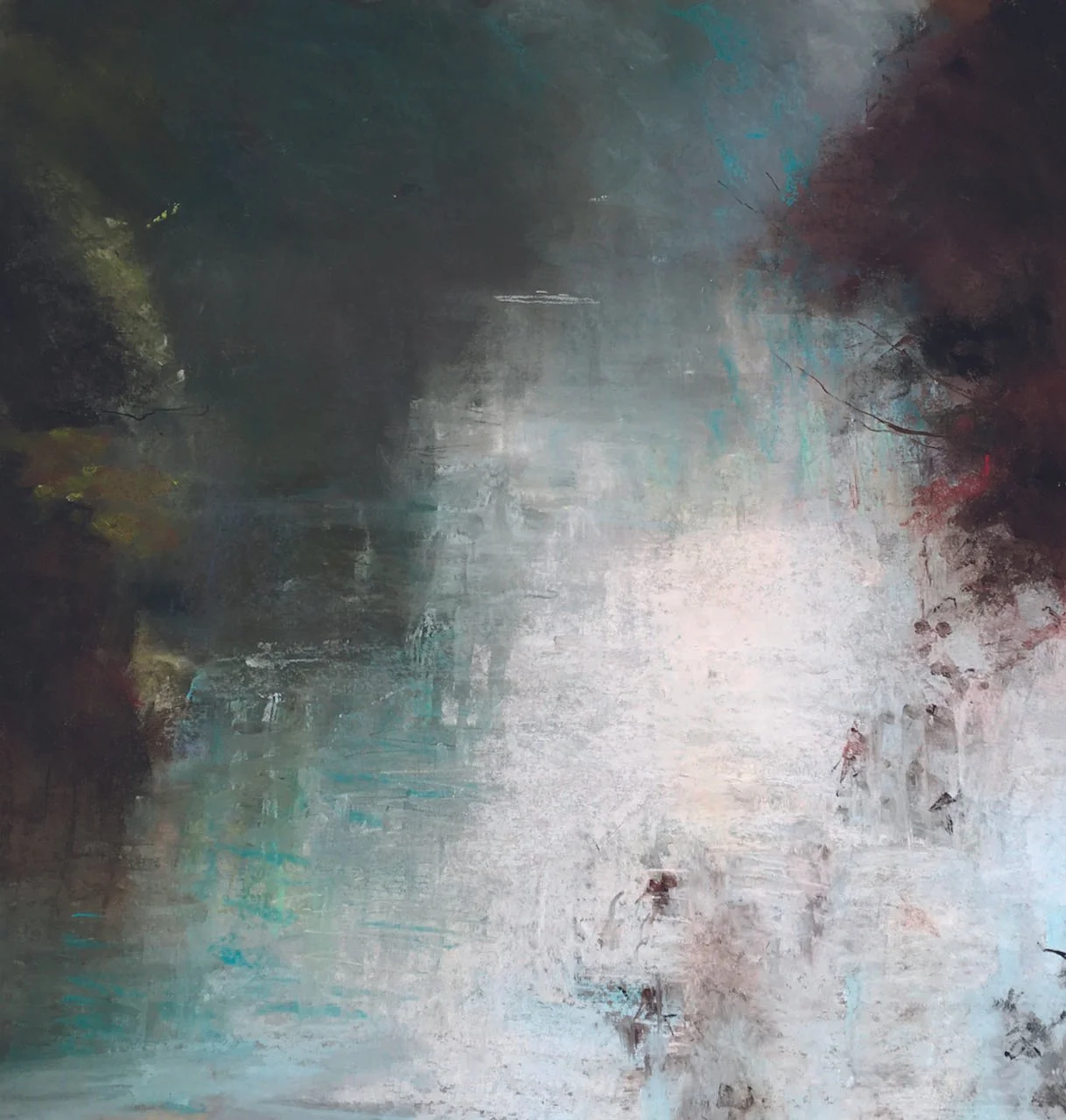
‘Light Between the Trees’ - Wendy McBride. Courtesy of White Space, Totnes.