DANIEL EATOCK
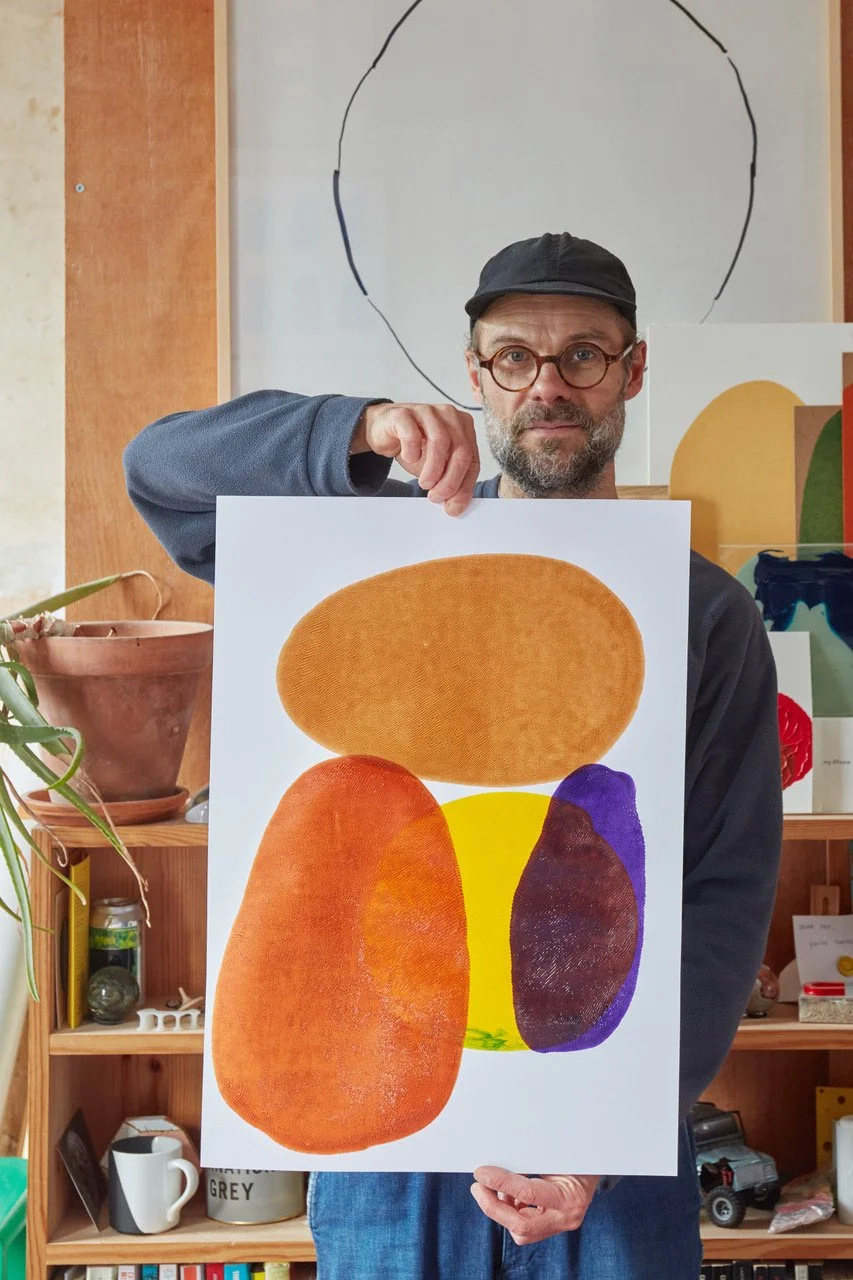
Daniel Eatock in his studio
Welcome to the fifth Other Ways of Seeing conversation. Woohoo number 5! Other Ways of Seeing is a project to discover the personal or not so personal art practices of people who work in the creative industries. Now I’m walking on thin ice here because for the person I’ll be talking to - conceptual artist Daniel Eatock, there is no distinction between personal artwork and commercial art.. it’s all art. And it’s all work. He also has issues with the term ‘Creative Industries’ and what that means to him.. or what it doesn’t mean to him. I mean, I possibly need to edit my whole intro and description of this podcast and project. And that was what our whole conversation was like.. mind-bending. You can almost hear the cogs in my brain grinding away.. Dan has an incredible knack of making you look at things differently and question what you thought you already knew. It was a gift having that time to rework my brain. Stuff I will take away with me and use forever. I hope you do too.
Our conversation was recorded in Dan’s amazing studio in East London. We spoke about intention, the artist Ithell Colquhoun, painting and photography as mediums, Fontana, Dan’s rolling pin paintings, work and being creative. We talked about the ‘creative industries’ (you can’t see me but I’ve put that in inverted commas with my fingers), Andy Warhol’s Factory, compromise and collaboration, Dan’s film for Winsor & Newton with Maria Lax and his one minute circles and one hour circles. Lastly Dan explained how he came to think the way he does and honing that skill, every day.
Mel: We’re ready. Yeah.
Dan: Right, go.
Mel: So, uh yeah, let's talk about um how these conversations help you. Actually, we were just talking about that, weren't we? And how you don't have necessarily have the opportunity to ruminate perhaps?
Dan: You know what's funny the minute it's recording, no? It's different. So I'm going to pretend it's not recording.
Mel: Yes, just pretend it's not recording.
Dan: Switch it off.
Mel: Okay, switched it off. Done.
Dan: Yeah, so. Normally you I get so into making and just doing my thing in the routine that I'm aware of what I'm doing, but I don't.. I use these more opportunities like this just to step back and reflect and look at how it kind of enables me to look at my own work and make sense of it. So that's what I'm going to try and use this session for. A bit selfish really... I've invited you around, you can ask the questions, but I'm going to use it for my… to understand my own work and what I might need to do next. That's my intention.
Mel: But I think that's really interesting because if you tend to… I don't know, I get the impression that everything you do is potentially a piece of art. So then why would this be any different?
Dan: Yeah. That's that's a good observation. It's not that it's art, but I feel so that everything I do is with intention. So whether it's like washing my socks or making my lunch or figuring out what to do with my daughter at the weekend or making a painting or an exhibition. Everything is connected. And I really like the crossover between things. And there's a there's a set of principles that kind of inform all of everything that I do. So efficiency, delight, surprise.. trying to like transform the mundane or do very common things but slightly different to reveal some kind of magic. So that can be like with food or it can be with a painting. Or it can be with a conversation. So that's that's what I'm trying to do, just kind of live life in an interesting way, economically, fairly, trying to use truth and like a set of values that I don't know, kind of uncover like positive things and my actions are the things I bring into the world, be it like friendships, conversation, food, art. I'm hoping that things are better as a result of doing them.
Mel: So you're looking for a positive outcome, it's not just observational?
Dan: Yeah, it doesn't need to be positive. Like sometimes the truth or like I find like the truth is positive, but the truth can also be painful. So I'm not trying to avoid difficult.. like positive is funny because that suggests like delight and happiness which is great but I'm also totally open to all the spectrums of like perseverance and commitment and Sometimes like suffering or pain, if you're doing something that's hard, like physically hard, it can hurt, but that's okay. Your body will recover if you look after it. And sometimes, like your head, if you're doing a hard project where you don't know the answer, it can feel uncomfortable. And I think that's also okay. So you can sit with that discomfort, and knowing that ultimately you'll arrive somewhere better for it. So I don't seek out easy things. I like a challenge.
Mel: But then you look at that in a sort of, in a positive way.
Dan: In a positive way, yeah.
Mel: What was the last piece of art or whatever it is, something that blew you away? Something that affected you?
Dan: It’s a good question. So I answered this question a month ago when we agreed… so I'm going to read what I wrote. Because my first thought with that question is that that time stamps this moment because if I answer this question right now, it'll be one thing, but if you ask me the question tomorrow, it'd be a different thing. And if I answered it last week or the week before, so it's like very specific to a moment. So I'm going to read what I wrote a month ago and then see if it's the same today. So a month ago… So okay, so I saw this exhibition at Tate Britain.
Mel: Ooh, that was at, I don't know if it was the same exhibition, but we had it at Tate St Ives.
Dan: Yeah, so this totally blew me away. I don't know how to pronounce her name.. Ithell..
Mel: Ithell Colquhoun.
Dan: Yeah. So I went there with no expectations. I knew a little bit and I saw Alex Ferguson, the director of the tape, posted it on his Instagram that it was a last day. And by chance I was nearby because Danielle was doing a weekend cookery course nearby.
Mel: Danielle’s your daughter, yeah?
Dan: Yeah, so ah, that's perfect. She's doing that. I can go to this exhibition and uh I don't really like painting. Painting doesn't move me as a subject. I feel as though it's just pictures. I don't really… it's alright, it can be good and it can be bad, but I don't fall into painting. And it wasn't so much a painting that I liked, but it's more I could really sense the person in all of her work. So in her drawings and her paintings, I just felt this like strong presence of her, like trying to figure out who she was through making work. And I felt that she had a lot of… She was like very spiritual and her sexuality and like the work just somehow communicated like a person who lived a life exploring deeply for kind of about themselves and how they fit in the world. I loved it, I thought it was really good.
Mel: Did it resonate with you in that her work clearly represented her. I guess it is with all artists, or you'd like to think so, but your artwork is very recognisable, I think.
Dan: Right, so I yeah, I think she was like wearing her who she was. It was like very evident in her work. Some artists' works, I think, the work is slightly detached from the person. So you know, I think the best work is when it fits, when there's no there's no difference. So when you if you meet the person and you see the work, it feels like the same. There's no translation. It's kind of like, oh, that person makes that work, it makes perfect sense. And that was one of those examples. If my work does that, if you see that in my work, that would be like the ultimate compliment. Like I would like to think that me as a person and the work I'm making is connected. Like if you meet my work or meet me, it's like, oh yeah, I can see how those two things fit together. And it's not the aesthetic of the work, it's kind of like because my work is very varied… like I do, recently people think I'm a painter because I've done a lot of paintings.
Mel: Yeah, the fact that you said you don't really, you're not into paintings, but then you make paintings.
Dan: I do, but not as a painter.
Mel: No.. I see.
Dan: So I've I've made a lot of paintings in the last four or five years, but that's just one small thread of my bigger practice. My practice is more language-based. And with the paintings I guess they're all iterations of an idea of trying to find truth for painting. Because painting.. I think painting is nonsense. It's all a lie. It's not, it's not real. Like you look at a picture of something and it's not real. It's not a mountain. It's not a bowl of fruit or a plant or a person. It's just a depiction of that thing. It’s fake, it's not the real thing. So why not just look at a real mountain or a real bowl of fruit? It's miles better than a painting.
Mel: How would how does that feel with photography then?
Dan: It's the same.
Mel: It’s the same thing..
Dan: Photography is good, it’s nice.. I've got pictures of my daughter when she was younger, that's great, like memories, but as a medium to express something, I just don't get it. Like why would you… go to the place and see it. I don't understand why you would recall like people so looking at reality through the lens of the camera or the phone when they're they're spoiling the moment very often, I think. Just to capture it as a memory. So it's a tricky balance. How much do you.. Sometimes I take photographs of like moments which won't be there forever, like a little moment of serendipity. I'll capture because then the picture pauses like a transient thing. But the Eiffel Tower will be there a long time, so I don't wouldn't need to take a picture of that.
Mel: So how do you feel about, you know, it always sort of blows my mind as well when you go and if you see a gig or something and people have got phones and they're recording it.., as they're watching it, or they're watching it through their phones, and it's there, and the live people are there, and there's everything to experience. I maybe they're recording it, I guess, for prosperity..
Dan: Or like a souvenir, yeah. There's no right or wrong, that's just my.. sometimes like I feel like I would like to get my phone out to record a friend who's playing a gig, and it's like.. but then I'm aware, do I break my rule? It's like a bit of a rule, I try not to, but sometimes I break that rule and I will indulge in just getting my phone out and having that memory, recording a memory, but it's not I don't know. I don't do it without thinking.
Mel: Do you watch it after?
Dan: Good question. I'm not sure.
Mel: It just stays there forever in your phone.
Dan: Yeah I don’t know what I do with it.
Dan: Yeah. But on the paintings, so by being aware that paintings of this, even abstract paintings feel they're not really truthful, then I started to make these paintings about.. Because a painting is always on the surface of either paper or a canvas or something. It's a flat plain, and that plain is trying to represent something. Even if it's abstract, it's trying to represent depth or an emotion or something. It's an abstract representation of something real. So I thought what it maybe there’s a way of making a truthful painting that acknowledges the surface. So I was kind of.. The painter that I like the most would be Fontana, do you know the Italian artist who slashed the canvas?
Mel: Oh, yeah, yes.
Dan: So he broke the illusion of the surface. So by cutting the canvas, you look at the surface but you see beyond, and you can see the darkness that leads to the gallery wall. But the illusion is broken. So I feel like that's a really important moment within painting. So he's broke the surface, but I thought, can you.. is there a way of acknowledging the plane, the flatness. So I started to make these paintings working with a rolling pin where I would roll shapes. And I feel that each shape that I roll is an attempt To try to create an icon of flatness. So we have these symbols. So my background comes from graphic design, and kind of my favourite part of graphic design was trying to like summarize a very complex bit of information and to simplify it. Not remove important things and make it um.. not reduce it so it's dumbed, but try to communicate the complexity in a single icon or image that represents something bigger. So it's like, for example, like a logo for something. So if you're trying to create an identity or a logo for a television programme or a corporation, that logo has to communicate a lot, that symbol. And it's interesting to try to… you have lots of conversations, everyone's got their input, and how can that manifest in a single thing that communicates what the values are of that organization. And with my paintings, I feel as though these shapes, these are trying to be symbols that represent flatness. So if you think of like shapes, like certain shapes represent different things. Like we've got the male and female shapes you might see on bathroom doors. You've got the love heart, which you have on social media notes to say I've seen it and I like it or it might be Valentine's Day or it's love or romance then you've got the emoji of a thumbs up which is like kudos or well done. So if these symbols, like what is a symbol that would talk about flat.. flatness? There isn't really. So there's symbols that talk about three-dimensional or kind of circular, like there's the yin-yang. There's all kinds of symbols for different complex things. But flatness, and flatness is really present in all of our lives now, because so much of our interaction is through screens which are flat. But yet often the design is intended to replicate something which is real or three-dimensional. So I'm totally waffling here.
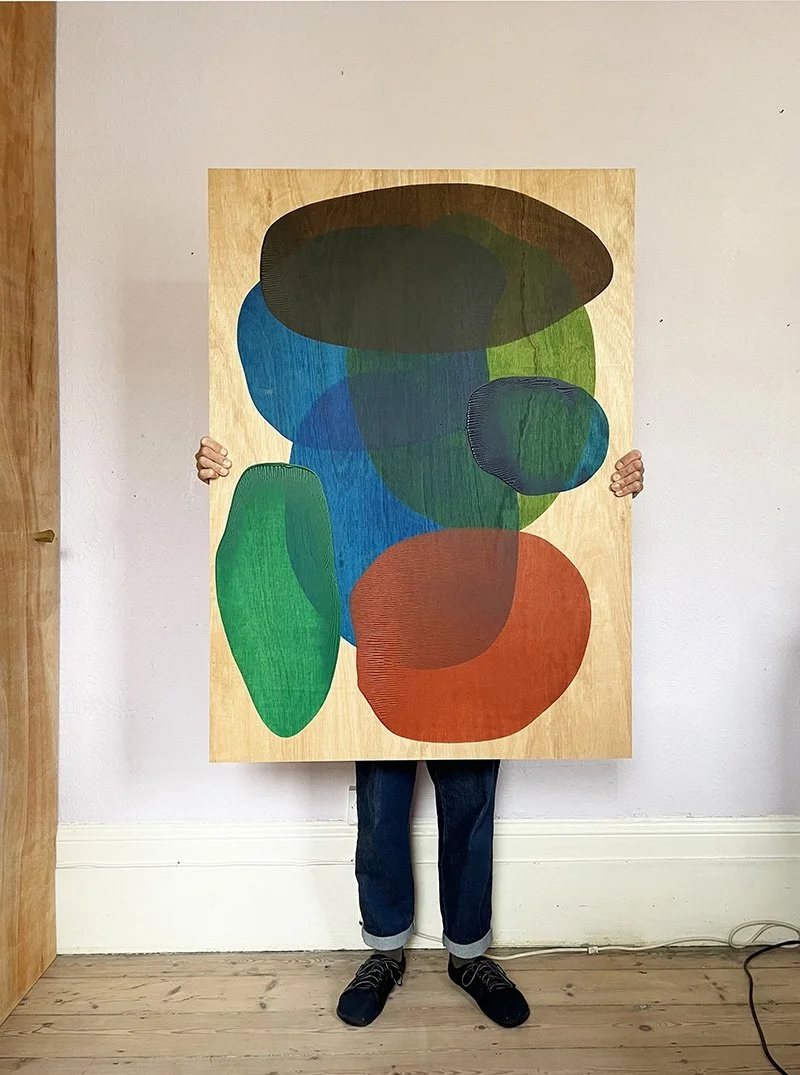
Rolling Pin Painting on Wood - Daniel Eatock
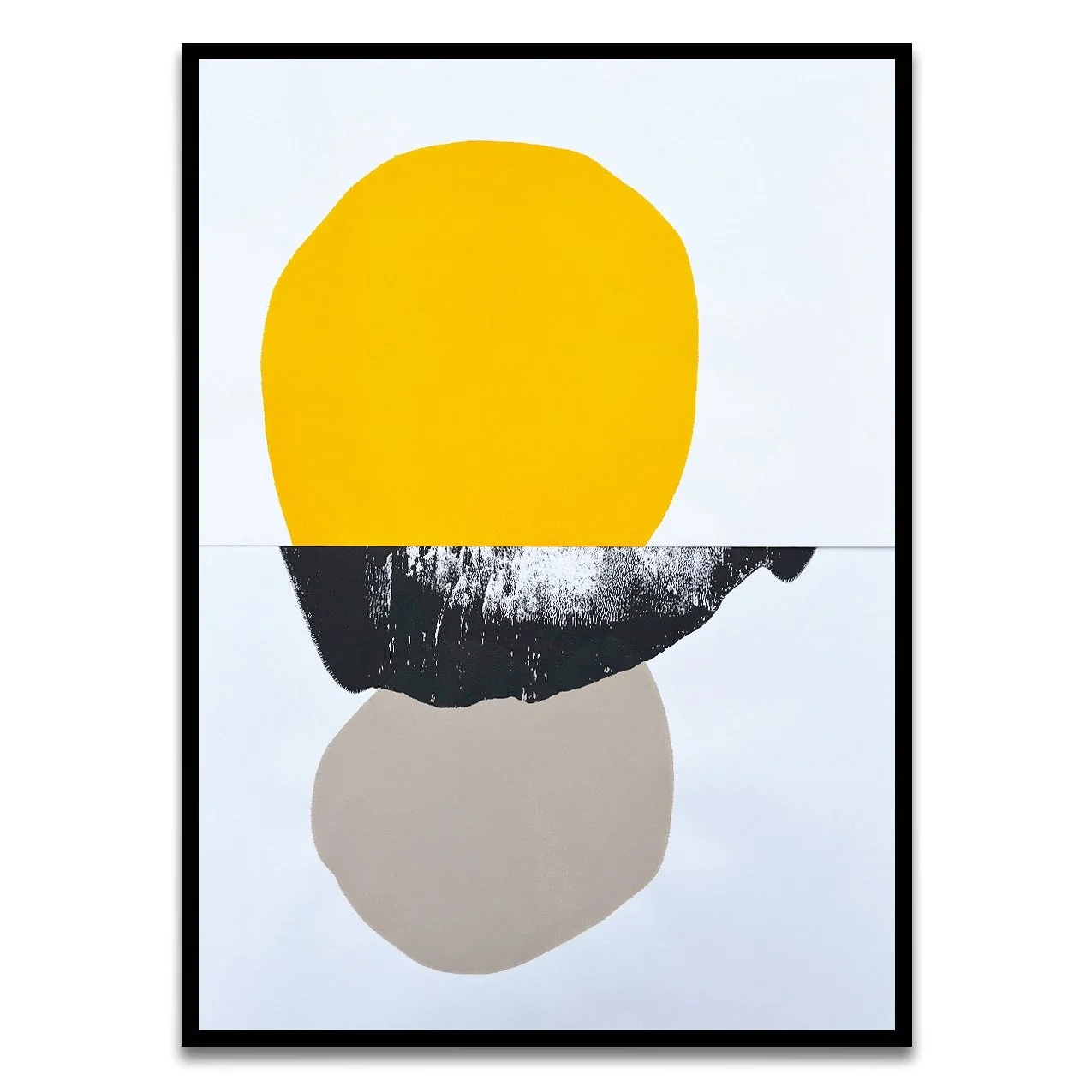
Rolling Pin Painting on Paper - Daniel Eatock
Mel: No, I love it.
Dan: So by working with these shapes, which are made with a rolling pin, they're all the paint's pushed, the shape is elongated. I'm not drawing that shape, it's kind of formed from a process. And I feel at some point I'll arrive at one shape, and I'm like, that's flat, that's the perfect representation of flat. So the paintings are kind of constantly trying to do that, and each time I roll a colour, it's an attempt, but I change the colour so you can see a composition emerging rather than always working with the same colour. And then once the canvas is filled, that's a painting that's done. And then I'll work to move to the next one. And I see the paintings almost like the surface of a pond. So on a pool of water you can recognise a surface, where you can see through the surface to the depths. And on the surface you can see the reflection of the sky. So in that one plain, you've got infinity, because you've got everything above.. Beyond, but it's kind of held on that on the meniscus, on that surface. And my paintings have tried to kind of work in the same way.
Mel: So I'm looking at one of your paintings now.
Dan: Yeah, that's not a very good one.
Mel: Oh okay.
Dan: Or that one. So you're in my.. so my studio is like unfiltered. I'm this is what I'm working on right now.
Mel: What about that one then?
Dan: Yeah, so that's a better I think that's a better example. Yeah.
Mel: So where does.. So they're all representations of flatness.
Dan: Yeah.
Mel: And they are yeah, so they're still representations, aren't they?
Dan: Yeah.
Mel: Or symbols of flatness..
Dan: Yeah. So, what I'm saying doesn't make sense. There's no scientific logic. It's very poetic. If you try to, it's like if you listen to the lyrics of a pop song, literally, you'd be like, hmm, that sounds a bit sounds a bit nuts. Or if you try to rationalise a poem, then it disappears. If you look at a joke and analyze it, then it's not funny.
Mel: If you look at it too much basically..
Dan: …so with that, like my intention, what I described there, if we start to pick at it, then it's almost like there is nothing. There is nothing there. But that's my guiding framework for making the work. So they're kind of like a set of principles or goals or things which I work with that's enabled me to make lots of work using paint. I've not studied painting, I don't feel like a painter, and I don't like colour, and I don't ever really like painting, but I can now engage with that activity.
Mel: I kind of understand, where you're coming from in that as a graphic designer…
Dan: I’m not a graphic designer.
Mel: You’re not a graphic designer, but you studied graphic arts..
Dan: No, I studied graphic design and communication.
Mel: You studied graphic design and communication… but I can sort of see where you're coming from when you were talking about how you've worked, you've done commercial projects, which you there's no… I can see we talked about this before when the first time I spoke to you and I talked about Other Ways of Seeing and that you know it was uncovering personal art practices. And you said, no… that's not what you do. And you don't see a distinction between commercial and personal work.
Dan: It's all work.
Mel: It’s all work…
Dan: Work is a beautiful thing, like work suggests, like labour and like people want to work and then have a rest, or wait for the weekend, or go on holiday. So that's like If you're living your life thinking I'm working from nine till five and then I can have a rest, and then at the weekend I can go crazy, and then in the summer I go on holiday. That feels crazy to me because the work is a delight. If you can find the thing that you love doing, then there's no work. I call it work because I'm active, like I'm engaged, and that's my favourite way of being or of being asleep, but not in between. I don't want to relax, I want to be active. and like participating and open to all the beautiful things that being awake affords, or I want to be asleep. I don't want to be passive and like numb and not seeing. So if I'm active, I call that that state is like a working state. It's like it's great, I can make things, I can do things, I'm recognizing things, making connections. That's my favourite way of being. So regardless of what the input is, if the input is a commission from somebody, like we need a billboard or we need a film to sell paint, like the recent project for Windsor Newton. Or if the input is there's an exhibition and and I'd like to explore this subject of Alvar Aalto, like the show that I just did, they they're all.. it's all the same. I don't differentiate because there's always relationships to navigate. So if it's a commission there's probably a client and there'll be a conversation to be had with somebody to make sure the thing I'm making fulfils what they need. If it's an exhibition, there's a conversation either with, sometimes it might be with a curator or a gallery owner or a museum or a project space director, but also with the audience. So there's a lot of compromise to take into consideration, all the people that might be encountering the exhibition. If I'm making my own work, then I'm considering my own needs. I don't make the work only for myself. I make the work, it has to resonate with others, otherwise there's no work. If I want to make work and it's me that sees it, then that's not art. Like does a tree.. if a tree falls over in the woods and no one witnesses it, does it make a sound? So it has to have an answer. It has to have the person witnessing it or viewing it for the thing to exist. Otherwise, it's nothing. So.. and it's never personal, because when I make work, even though I'm making it, it's in response to the world. It's the opposite of personal. It's like totally for everybody. Like it's in response to everything. And personal would suggest like it's inward looking, but it's outward looking. It's like really, I think making something is the most generous thing you could ever do because you're making that to share. And ideally, the best way… if everyone could see it, that would be the ultimate. If the whole world could see the work. that would be amazing. And that's the intention, I guess, when making work, like conceptually. I want it to be for everybody. Every single living person. So I think it's like, the most generous thing you can do is to be creative.
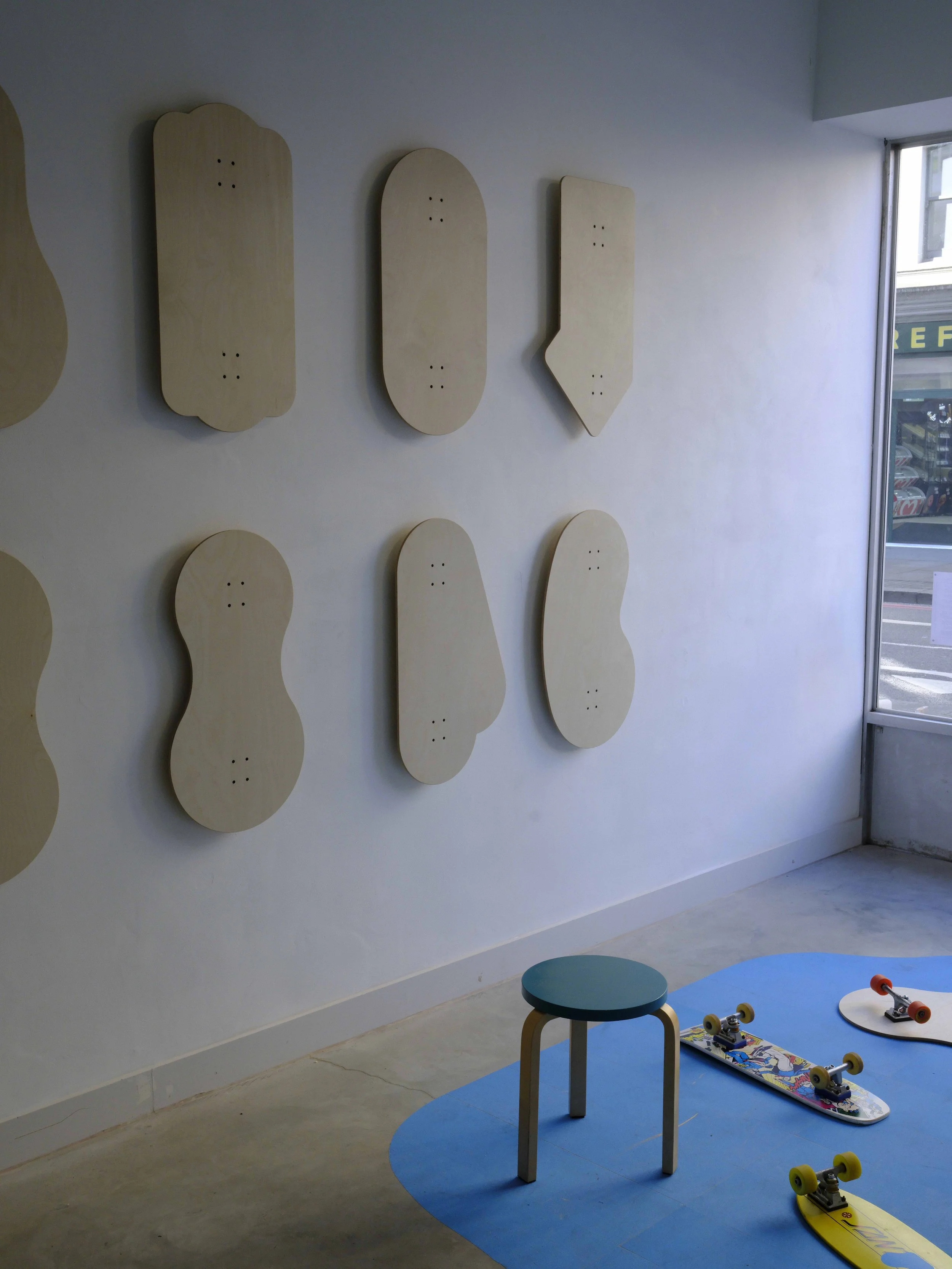
Alvar Wave and The Ripple Effect - Daniel Eatock & Ed Gill
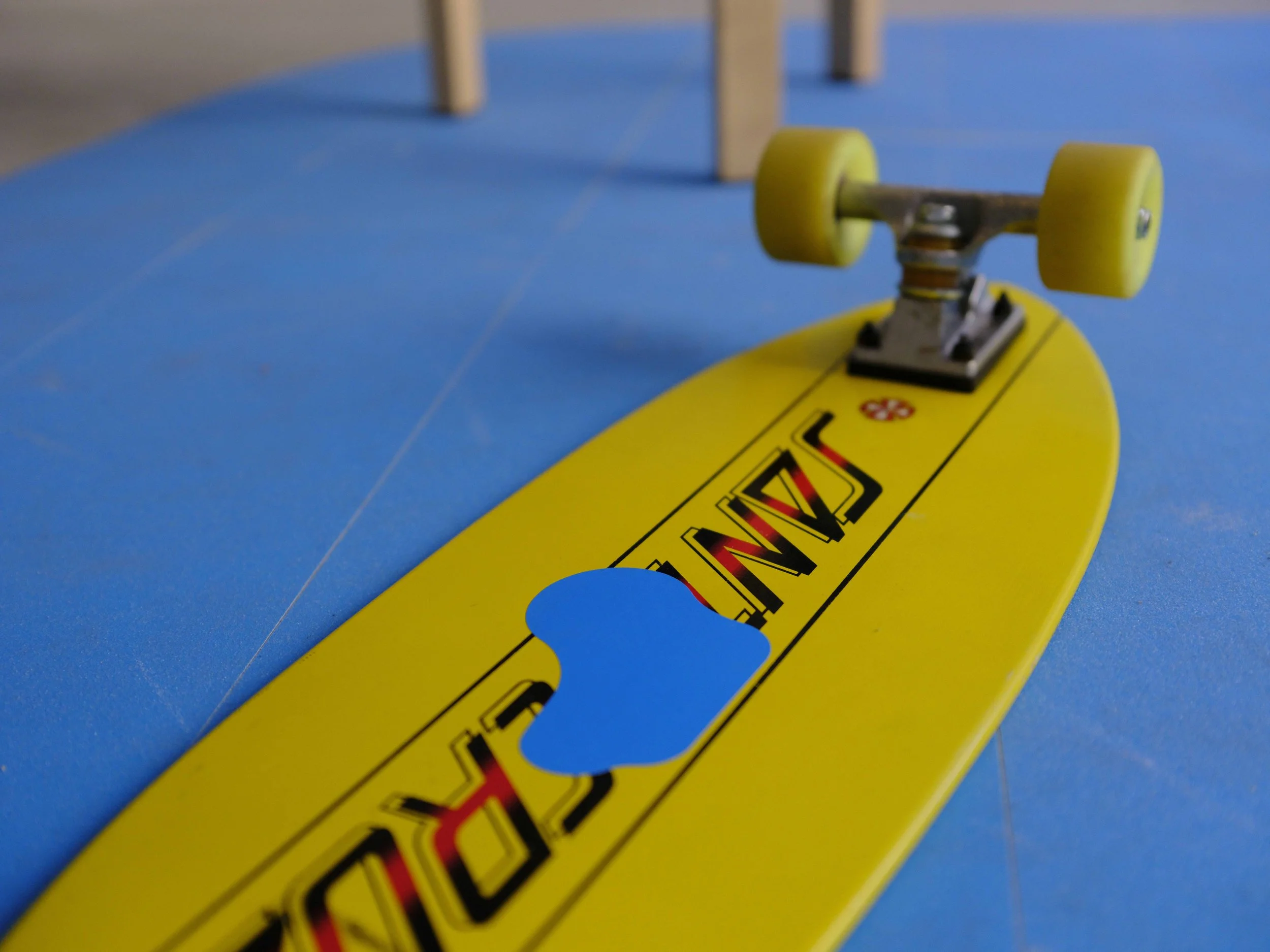
Alvar Wave and The Ripple Effect - Daniel Eatock & Ed Gill
Mel: Your work is very generous. You're very open to sharing. A lot of your work brings in other people to remake that work and for it to spread, but it still continues to be your work. And I don't think everybody's like that though. I mean, when I think of.. well of the reason this project came about really was because there are a lot of people in the creative industries. I know you have a problem with that as well. Who make work or something creative for money, and then but they feel the urge to still create for themselves. But you're saying it's not for themselves. It doesn't exist until you show it, until it's out there in the world. So maybe it's not personal, but they don't make it necessarily for money. So that's where that idea came from. Whereas for you it's like it's… you're constantly exposing your, whatever you create, and you're open to sharing it. There's nothing you keep close to your chest. Is that right?
Dan: There’s a lot of different things there to start with..
Mel: Yeah, I know… I just went bleaurgh...
Dan: So let's break all that down. Everybody's different, and what I'm sharing is my way of being and my views. And I don't want to… It's not the only way.
Mel: No, no. It’s interesting though, I love it.
Dan: There's certain terms that I find difficult. So Creative Industries. I think there's a company called Creative Industries. It's a nice name for something, because I find that it's almost like an oxymoron, really. It's like that juxtaposition of two things that are a bit at odds. It's like industry, or industries, kind of suggests like a like a factory plant in my mind. Like it's industrial or like it's like labor, factories. It's like in creativity… Do you know, like Warhol would call his studio The Factory, and it's the same thing, it's like, it's funny, like he knew exactly what he was doing there. Like, he's got a high turnover, he would employ people to make his work. And it was like, it was ironic, and it's beautiful. And he delivered that like it was his life. What a beautiful name for his studio. So creative industries is in if I see it in that way, it makes me smile, it's funny. But often it's used not in that way. Often it's like it's real. People like really think it's a thing. They're creative industries. And what is that? So it's people that are a bit like vigilantes. So it's like they… I what I see, and I could be wrong, but it's almost the vigilante doesn't necessarily believe that the person that they're looking for to kill is right or wrong, is they're they're being paid. Go find Jim. Jim's a bastard and kill him, and we'll pay you a million pounds. So they don't care about Jim, they just care about the million pounds. And advertising is very much like that. It's like nobody cares. It's like Coca-Cola, here's a million pounds, go and make a billboard. Fine. Or Marlborough. Or whatever it might be. And there's no alignment to in a way, and I think the more you do with that, you become detached from your own awareness of who you are in the world. And it's good that we can do that. It's good that human beings have that capacity because If we become too sensitive and only do the things that we like or love, then we'd probably never do anything. You couldn't walk through a forest because you'd be afraid of stepping on an ant. You could become overly sensitive. So we have to have a bit of robustness to kind of just exist as humans. And the spectrum of like where are your ethics and where do you, what do you embrace, where do you draw the line… it's never fixed, it's constantly like a conversation, like being aware of it. But going back to like, so creative industries… it always traps me. I always feel like uh like I don't know, there's something very uncomfortable. Because the creativity… what is creativity? So it… creativity is like being… What is creativity? It's just responding to mediums or to subjects in a way that's not scientific. So it's the opposite of… but you can be creative within science. They're all difficult things to define. And if you… again we kind of unpick it and it becomes a bit nonsense, doesn't it? But I guess ultimately I like the idea that I'm outside of expectations. I just try to live a life where no matter what I'm doing, I can be open to lots of different potentials that are not the obvious one. So if I have to get from A to B, rather than thinking I have to get a bus, then you could run, hop, skip, roller skate, skateboard… walk backwards. That it's a bit daft showing, but there's always different paths to do something. And I think it's just constantly being open that if everyone's doing it one way, let's try and find another way of doing it. And that I feel as though that's my role in the world, is to try to like shine a light or find different things to the expected. So that, and that can be almost within any medium. So I've taken that as my role. Like I'm a specialist at being a generalist and I can kind of apply some kind of logic in a poetic illogical way to almost any subject. So it could be painting, it could be time, it could be almost anything. and I try and find like a truthful way in. So if Coca Cola did come saying we need a project, then that's so problematic of like what you might do that I would then have to find a truthful way of engaging with it, and maybe that then would, I don't know, reveal something that is valuable for Coca Cola and for everybody else.
Mel: Do you compromise? Can you compromise? Is it a compromise?
Dan: Well, life is a compromise, yeah. Everything.
Mel: Is the compromise an opportunity to look at something differently?
Dan: I willingly kind of compromise before I have to compromise. So that life is full of compromise, isn't it? Like you have to.. you can't only do the things that you want to do. So that's like the opposite of compromise. If you only ever did what you wanted to do. So, what would that be? The best things are what? Eating chocolate and sleeping. Having sex. What would it be? Like, what's what would be the best things that you'd just want to do if you didn't have to do anything else? But if you did that all the time, you'd be ill.
Mel: Yeah.
Dan: You’d feel, you'd be sick.
Mel: I don't think it'd be fun anymore.
Dan: No, you wouldn't want to finish the chocolate. After being in bed for more than twelve hours, you’d be like... So, but if you.. if you apply I don't know, kind of like discipline, then I don't know, it's better. Those other things are better. Like, so it's almost like compromise before you have to. Put those things in place, so then you're in control of the compromise. It's not something that's like forced onto you, but you kind of willingly take in those compromises and when you're in charge of it you're empowered you've empowered yourself and then that's I think that's better it's a better feeling. So for exercise, for example, I run a lot and I lift weights and climb, and often my body's uncomfortable because of the stress that's been put on it. But that bit of discomfort Is a nice feeling because I know I'm getting stronger. And if I didn't do any of that, then you might have discomfort from being… you might pull your neck, or you might hurt your back by lifting a heavy bag, and that would be another kind of discomfort. And that discomfort for me would be unbearable because it's exposing a weakness. You've not trained, you've lifted up a bag and you've now tweaked your back. So that pain is like rubbish. You've not gained anything from it. Whereas if I climb and the day after I'm uncomfortable, I'm like, that's great. I've brought that on, and I know that that's the consequence of being strong, and I love it. The same with that, if I run long distances, then I can hobble around and it's uncomfortable, but then I've worked really hard to feel that uncomfortable and it's it's good. I embrace it.
Mel: You’ve chosen it.
Dan: Yeah, I've chosen it. So it's kind of the compromise is like is brought, and I've gone to it and and sought it out rather than it coming to me.
Mel: It’s a welcome compromise.
Dan: Yeah, yeah.
Mel: So in a situation where you're working with clients. Is that a welcome compromise when perhaps they disagree with what you've decided or a choice that you wanted to go down, or is that something that happens?
Dan: I don’t remember them disagreeing…
Mel: Yeah, okay, great. I guess they go to you for a certain reason, don't they?
Dan: I also see clients… like the first thing in a project is to try to become friends, not force a friendship, but it's much nicer working with friends or people that you trust. So if you can build that connection with a person, then I think you can do good work. It's like with Winsor & Newton, then Holly. Because I knew Holly through Matt, or I knew Matt from cycling and doing a long cycle ride together through Mike. So it's kind of like it's all these like knock-on effects, but it's not random. So Holly… yeah, she's not a friend that I would then call and say, ‘do you want to go to the cinema?’ or ‘do you want to see an exhibition?’. But if I saw her, I'd be quite happy just to sit and catch up and chat with her. And I think there's a lot of trust. She she came to the studio during the making, she saw where I was working and I think when there's a closeness, it's more… it's different to feeling like it's a client. I never felt as though I had to make work to please her. I felt as though because we understood each other, I could make work that I thought was right and she would be part of it. And I think all the work I've done is a bit like that. So it’s a…
Mel: So it's a collaboration?
Dan: It’s not a collaboration. Ultimately I’m making the work. But they're involved in the conversation. It is collaborative in some sense, but collaboration sounds like it's an equal thing, doesn't it? So it's more like they participate. Well, it's a collaboration, but it's not equal. It's not an equal collaboration.
Mel: No. But they have comments, I guess, so it's..
Dan: Yeah.
Mel: Yeah. Yes, I think that was one of my questions actually that I sent you where it was a question of collaboration with Winsor & Newton. Or was it commercial? Or is that… are they two separate questions, actually?
Dan: So what's the question?
Mel: The question was, with your recent collaboration with Windsor and Newton, would you consider that a commercial piece of work. So I've said it it's a collaboration, which to me it feels like a collaboration when I watch it because it's you speaking, it's you using their paint. And although Maria Lax directs it, again that is in is collaborative as well. So it's sort of a three-way collaboration. And yet it's a commercial piece of work. But is it a commercial piece of work?
Dan: Well, I think the collaboration… Maria and I collaborated. That's a collaboration.
Mel: Okay, that's a collaboration.
Dan: So that feels very openly like.. I wouldn't have made that work like that, and I think Maria wouldn't have made that work like that. So by coming together, that's the collaboration.
Mel: Right.
Dan: Now, Winsor & Newton were They're not the collaborator, they were maybe the instigator, or they were the reason that piece of work came into existence. But to be really brutal, that piece of work could have existed for a different paint manufacturer. So it's not it's not bespoke for them, it's kind of… they make the paints, and it happened that the woman that worked there, there was a connection to. So it kind of opened the possibility to kind of explore their paints. But they were really valuable in the process. They were generous in providing both materials and the space to share the work afterwards. And open to receive something that was a bit outside of what they would normally receive. So they were… collaborator is not the right word. Instigators… or um yeah, I don't know. And then but um… commercial…. like I, because I studied design and communication, like I'm… again it's a funny thing, isn't it? Because I guess everything I do is commercial in some senses because I… Do you know if I'm aware that to exist, like I live, we live in London, I live in London… and you have to I can't not survive. I have to find a way of existing. So when I'm making work, that's always part of the, it goes into like the work. Does this work… can I live from this work? And I don't make all the work to sell. Some work, some projects are just like research projects, but and I'm aware that long term that project might lead to something that potentially might sell, or it might attract a project, that brings some finance that if I hadn't have done it. So everything kind of feeds it feeds each other. And the Winsor & Newton, there was money, there was a budget, and part of that budget was to bring people on board that had skills that I didn't have, and also to give a fee. And I was quite happy that the work I made represented my work and that they could use it and showcase their paint. There was no compromise where I was feeling like I had to paint or change my work because it was for them to then share to bring attention to their paints. So it was, my work came first, like it that was the pure thing that I did. Maria recorded it. Then I wrote a poem about colour, which was kind of adjusted to fit the thing and in a way we all kind of we all benefited from it. Maria made something, she's got something, I got something. And ultimately, Windsor and Newton have a little thing that they can then share, which draws attention to their products. So it’s a…
Mel: Win-Win.
Dan: It’s a Win-Win-Win.
Mel: It’s a beautiful piece of work. I mean, I love it. It's very engaging.
Winsor & Newton ‘Full Spectrum’ - Daniel Eatock & Maria Lax
Dan: And since making it, because it's quite quick, it's almost I don't know how long it is, but it's not long. So I see it almost like a trailer, like a film trailer for something that could be a lot longer. So it's quite fast paced and I would love to make like a half an hour or a one hour version. The same thing but… so if you don't when you see like a film trailer usually the the film trailer's got a lot more energy than the film because the film is an hour and a half or two hours and the trailer is like three minutes so there's quite… it's trying to kind of communicate quite a lot in a short space. And I feel as though this if we see this piece of work as a trailer, imagine what the film might be. It would be much more calmer.
Mel: Would it?
Dan: And longer.
Mel: Right.
Dan: And I think, wow, that would be nice. I'd like to make that.
Mel: Would there be more poetry or would there be pauses?
Dan: Well the poem is a lot longer so that was quite edited. So I it's actually I think I could be wrong, but I think it probably that's probably like twenty percent.
Mel: Oh, there really is a longer film then in this.
Dan: So it could be longer. And it doesn't need to be continuous either. Like I I think it could be delivered in a way… Whether the film will ever happen or not, but I just like the idea that that's the trailer, and the film might exist one day.
Mel: Maybe it exists in people's minds. It's very mesmeric, and I feel like you could go away from that film and continue that poetry in your head, looking at things around you.
Dan: Yeah.
Mel: It’s very mesmeric.
Dan: ‘Mesmeric’. Is that is that a word?
Mel: I don't know.
Dan: It’s so good, isn't it?
Mel: Mesmerizing, mesmeric. I don't know, I think I've just made it up.
Dan: If you have it, it should be a word. Or if you've not, then I've not encountered it.
Mel: No, but I think I'll just made it up.
Dan: Nice. Well done. Creative. Was that a collaboration? Because I spotted it.
Mel: Maybe it is. Boom. We've collaborated!
**********************************
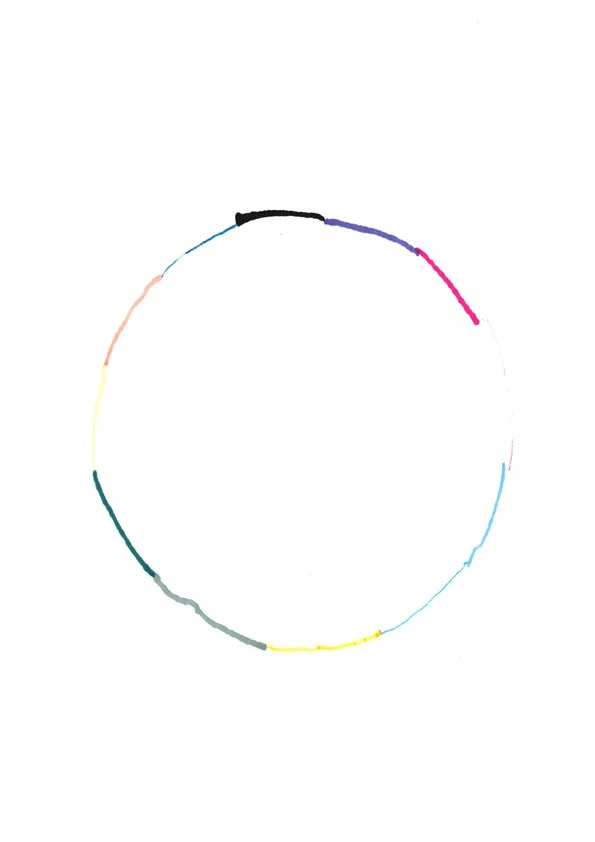
One Minute Circle with 12 participants
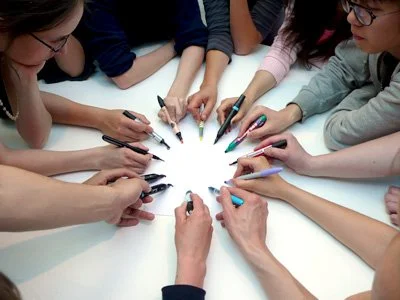
12 participants drawing the One Minute Circle
Mel: This is again working with people, and there is the picture of reimagining a minute, sixty seconds. What I'm looking at now, for the people who are listening, is a picture on Daniel's wall, which is a circle that's been made by ten different people.
Dan: Twelve.
Mel: Twelve different people.
Dan: If you can think of a clock face. So there are 12 numbers from 12 at the top, 6 at the bottom, 3 at the quarter past, and 9 at quarter to.
Mel: So everybody… everybody's drawing 5?
Dan: So everybody's drawing for 5 seconds. So the combined time is like, it's like if you watch the second hand go around the clock, so it goes to.. It starts at the top, works five seconds, and then it's at one. So twelve people sat around the piece of paper. And each of them was instructed to draw from their line over five seconds a curved line to connect with their neighbour's line. And after five seconds the circle emerges. So the combined drawing time is one minute. But the moment to make it was just five seconds, because it was a collaborative exercise. So it's a really.. I think it's interesting just to think that thing was made in five seconds, but the combined time is a minute. When we look at work, very often I think if you look at… if you take a child to a museum and they look at paintings, I think one of the questions is, ‘wow it looked like it took a long time to make that painting’. So you you equate the labour or the time it takes to make something with its quality.
Mel: It’s so true!
Dan: If a child spends a long time colouring something in, then because it might have taken them an hour, they feel like that's precious. But really with art, I feel as though the time is irrelevant really to the quality of the piece. It doesn't matter if you've made the work in five seconds or five years. Or five hours. It doesn't matter. The quality can be… something made in five seconds can be better than something made in five years. It's like the idea or the intent.
Mel: And everything that's gone before.
Dan: Yeah. So these drawings that I've been making to do with time are very literal translations. So it's a circle is like the best form or a form that is time based. So if you think we're on Earth, which is a sphere, and the Earth is rotating, it does one rotation every twenty four hours. And like our clock is kind of based on that. So a clock face, it does one rotation for every hour. The second hand does sixty rotations for an hour. And to start kind of working with those things, like to draw 60 circles in one minute that overlap those, that's like… it's nice to look at because that scribble is like one minute, or to draw one circle in one hour, you can see the slowness of that pen has travelled over the paper. So the paper has absorbed the ink, so it becomes you can sense that the pen has travelled very slowly, the line is a bit wobbly, and obviously it's more difficult to draw an accurate shaped circle slowly.
Mel: Have you done that?
Dan: I’ve done it many times.
Mel: Did you do that, yeah?
Dan: Yeah, there's a picture of it in my book.
Mel: Okay. I thought so.
Dan: Yeah, so I've done lots of iterations of circle drawings with.. on my own and with participants, all linking back to time. So the biggest one was: I had 60 people around a really big piece of paper, and each person drew for one second.
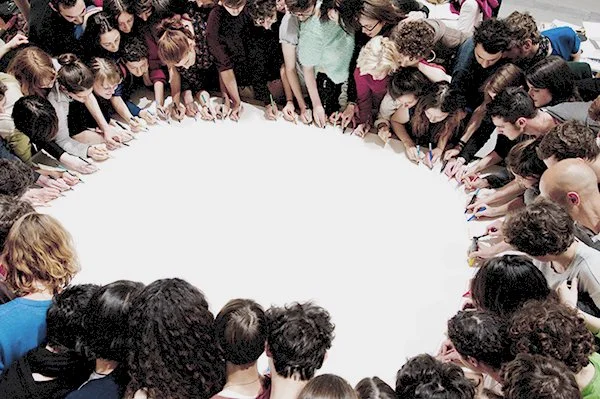
60 participants drawing One Minute Circle

One Minute Circle with 60 participants
Mel: Wow And then each person drew for one minute.
Dan: So there are two drawings that both were circled. One was an hour, one was a minute. But it took sixty people simultaneously drawing to create it. Yeah.
Mel: Fantastic. So much of your work is looking at things differently. And it's so inspiring being just being with you because you do look at things differently. You see things well… when we speak on Zoom occasionally and the last time we had a we had a conversation on Zoom, we had a meeting and you you know, we were talking about approaching brands and and you really made me think in a different way and how to approach people and how to look at it differently. And is that something you've always done or do you think it's… you've been trained or is it just experience through life or is it something, you know, as a child perhaps? I was sometimes because I have children, I sometimes look at them and think, ‘are you always going to think like that?’ and I hope you do.
Dan: Yeah.
Mel: And is that the same for you? Have you always sort of viewed things in your way? Or is it something that's been a practice that you've honed over the years?
Dan: Yeah, both. I think I recognised early, that I was dyslexic, so I had to find other ways of arriving at the solution or the thing. So you kind of you take… like I'd often have to like do a different path to arrive at a solution. And then it's like anything in life, the more you do something, the better you get, the more fluent you become at it. So, that part of my brain that kind of thinks around things. I'm using it all the time. So I've become an expert at doing that. It's like if you.. whatever you put your time in, you will get the… If you only make sushi, you'll become brilliant at making sushi. If you only ever run, you'll become a brilliant runner. Whatever you put… so my, the way of thinking about problems or work or and describing work or sometimes making a solution before there was a problem. Like this, I've done it since being I don't know, like from being 14, I'm now 50. So it's a lot of time that I've had to kind of develop it. And it's almost like the older I get, the calmer and easier it becomes because I know I have the confidence that I can unpick a problem just by sitting with it. I'm not afraid of the discomfort when I don't know. It's okay. I will find it. And I feel I don't know that I don't feel competitive because I just know that I will get to a solution that other people… they would do their solutions and now I'll arrive at my own version of it. And I really like my version of these things. And I don't compare it anymore. It's just kind of like, no, that's truthful to me, and I think it's good. And it's a nice contribution to the world. So it sits really comfortably. But it is a practice that I'm honing it every day. Like I don't try to take time off. I love the practice, like having a daily practice with all the things like parenting, running, meditation, eating healthy, making art, friendship. They're all things that the more you do, the better you become at them. So do them every day. And don't wish for it not to be there. Don't wish for your projects to run out or don't wish… like wait for a holiday or a weekend. But the day is the… right now is the best moment. Right here, right now, we're doing this, and it's the best it gets. And then, afterwards, the thing that comes next will be the best that that is. And it's kind of like life, it's like that. So, just keep doing each moment, it's like… the best.